
















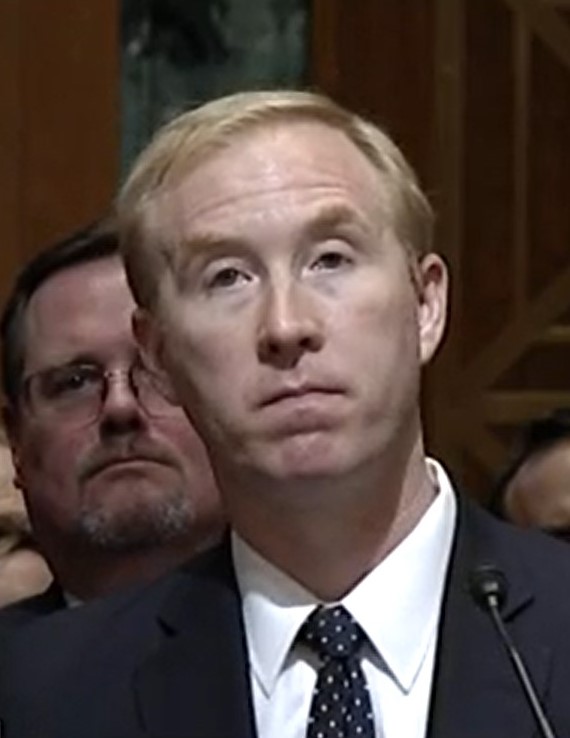
Patrick Urda
YTMP exclusive by Peter J Reilly.
Patrick Urda, Chief Judge of the United States Tax Court, did not leave us in suspense as to where he was going in the case of Lake Jordan Holdings LLC. He wrote:
“Once again in the conservation easement context, we return to the old question: “Who you gonna believe, me or your lyin’ eyes?” Lake Jordan Holdings, LLC (Holdings), claimed a charitable contribution deduction of $12,740,000 on its 2017 tax return for the donation of a conservation easement over 157 acres of rural property in Elmore County, Alabama (easement property). Outside the current environment, this value would be truly remarkable. A 96% stake in Holdings, whose only asset was 165 acres of land — the easement property and eight adjacent acres of odds and ends — had cost $583,000 a few months before. In conservation easement world, however, it is just another day at the office.”
If you have been following these cases, it is the same old same old. Judge Urda blew off the various foot faults that IRS tries to use to totally deny the deduction. He also does not allow the the civil fraud penalty asserted by IRS. The civil fraud penalty or 75% is about as bad as it can get short of forfeiting your liberty.
He allows an easement deduction of $1,091,760 which is far enough from the $12,740,000 claimed to qualify for the 40% overvaluation penalty. Nonetheless, it is pretty generous compared to the $583,000 for which the 157 acres of rural property in Elmore County, Alabama had been acquired a few months before the donation.
The Interesting Bit
The Lake Jordan deal was put together by Nancy Zak of Forever Forests LLC. Ms. Zak along with EcoVest was one of the defendants in a 2018 DOJ lawsuit seeking injunctions. She settled in 2021 agreeing to a permanent ban on organizing, promoting or selling any plan or arrangement involving a deduction for a qualifying conservation contribution, payment of an undisclosed sum and a notification about the injunction to everyone who had bought into one of her deals.
Judge Urda gives us a sort of brief course in the creation of a syndicated conservation tax deduction. He notes that the business required finding inexpensive properties that could deliver high valuations at least on paper. Since such properties are hard to find, Ms. Zak “essentially made her own”. Drawing from e-mails we learn that the “most successful candidates for easements are properties that can be purchased at a small cost, hold great value when developed at their highest potential, hold great conservation value and are in the path of ongoing development”. There was a general rule of thumb that the highest and best use value when developed needs to be somewhere in the vicinity of ten times the cost of the property.
Ms. Zak was obtaining ten to twenty such properties per year. Judge Urda saw the process of assigning a highest and best use to the property as an exercise in creative writing. Ms. Zak and her team and the appraiser would prepare multiple drafts of appraisals showing purported values of never-would-be developments.
They would also set up the entities needed to consummate the deal. There was an LLC (PropCo) owned entirely by the original property owner but managed by one of Ms. Zak’s entities. Then there would be a second LLC (InvestCo) owned by Zak entities. The owner transferred the property to PropCo. InvestCo would agree to buy a large percentage, but not all, of PropCo from the owner. Shares of InvestCo were priced so that investors would get $4.50 of charitable deduction for every dollar invested. At the top federal individual rate that translated into $1.78 in tax savings for each dollar invested. That left a lot of room for the deduction to be cut before the investor lost money. If they put the tax savings in high-yield investments they could come out ahead even if an audit substantially cut the deduction.
The fixed ratio also served the function of making the interests essentially fungible. The beauty of these deals was that they were generally sold at the end of the year when people with sharp tax preparers/advisers would be able to have a pretty good idea of what their balance due would be. Those advisers were a marketing channel to investors.
A Return Problem
When InvestCo bought the interest in PropCo, the sale created a technical termination of the partnership. That meant two returns needed to be filed for the year. The preparer of the return had it in their minds that the short period after the transfer had to start the day after the long period the day before transfer. Both the technical termination and the donation took place on December 29, 2017. The preparer had the first return end on December 28th. The IRS tried to make a big deal out of this, but Judge Urda was not having it.
The Lakefront Development That Never Was
The original appraisal called for a 308 unit lakeside residential development. At trial Charles Hewlett saw that there would have been an opportunity for a more upscale 157-lot development. The IRS argued that highest and best use was low-density development on the waterfront and recreational use for the interior acreage. The judge found the IRS view more convincing.
The judge noted that the seller of the property who was sophisticated had not taken the “purportedly” extremely lucrative potential use into account when agreeing to sell. Here is a pro tip. Whenever you see any form of the word “purport” in a Tax Court opinion, things will likely not go well for the taxpayer.
We also get to learn a little about where to vacation in Alabama. Lake Jordan may be nice but it is not Lake Martin,
Lake Martin features high-end residential subdivisions, as well as 14 marinas offering fuel, boat sales, boat service, and sundry items, 10 restaurants located on or just off the lake (one of which was recognized by the James Beard Foundation), and multiple golf courses. ……..
This is a far cry from the easement property’s location in the remote area of humble Lake Jordan, which has no commercial conveniences, no restaurants, and one marina that sells neither food nor ice.
When it came to comparable sales, the taxpayer’s expert selected properties sold on Lake Martin. There is an extensive discussion of the discounted cash flow valuation that the taxpayer’s expert put on.
Our observations on these points are not meant to catalog all the flaws in Mr. Eidson’s discounted cashflow analysis. Rather, this brief stroll through Mr. Eidson’s work simply highlights the problem with an income method analysis untethered from a historic track record; it can be used to combine speculation and unreliability to generate a baseless value.
As I remarked at the beginning it is pretty much same old, same old for syndicated conservation easement cases.
Civil Fraud
Judge Urda allowed the IRS to make its case for the civil fraud penalty, which is really nasty – 75%. He notes
The Commissioner faces an uphill task in proving fraud here given that Holdings expressly disclosed on its tax return the principal facts about the easement donation as the Code and Treasury regulations mandate in their various substantiation and reporting requirements.
Judge Urda shows some sympathy for the IRS seeing Ms. Zak and her associates as sophisticated business people exploiting a perceived flaw in the Code, generating a lucrative return funded by the public fisc for giving away essentially nothing. Not to mention so low-grade dishonesty such as backdating. In the end, though he did not find civil fraud.
The Court shares the Commissioner’s frustration with the mix of sophistry and cupidity at the heart of this transaction, as well as the utter waste of time and money spent in untangling the ins and outs of this abusive scheme. Fraud this was not, however.
There was not any question about the overvaluation being gross, so the 40% applies.
The Beat Goes On
This is one in a now a long line of cases in which the Tax Court focus on valuation with due notice to what promoters actually acquire the property for is disastrous for easement investors. I haven’t figured out what the next new thing is that has taken the place of syndicated conservation easements. It appears to me that the income tax falls most heavily on people with high salaries and relatively low wealth. Beyond retirement savings, there is not a lot to be done about it legitimately. It worries me that a lot of the investors in the SCE deals may have been those sort of people. The heart of the industry was in Rome GA, which was something of a medical center.
—————————————————————————————————————————————————————————
For great value continuing professional education. I recommend the Boston Tax Institute

You can register on-line or reach them by phone (561) 268-2269 or email vc@bostontaxinstitute.com. Mention Your Tax Matters Partner if you contact them.
For articles oriented toward tax professionals check out Think Outside The Tax Box.
T
Your blog is a beacon of wisdom, always intriguing your audience with profound analyses. It would be enlightening to see you explore the convergence of these themes with innovations, such as artificial intelligence or sustainable practices. Your knack for parsing details is truly remarkable. Thanks for consistently delivering such thought-provoking content—I’m eager for your next post!
Access: https://crowdlinkbuilding.com/
buy links sell links