


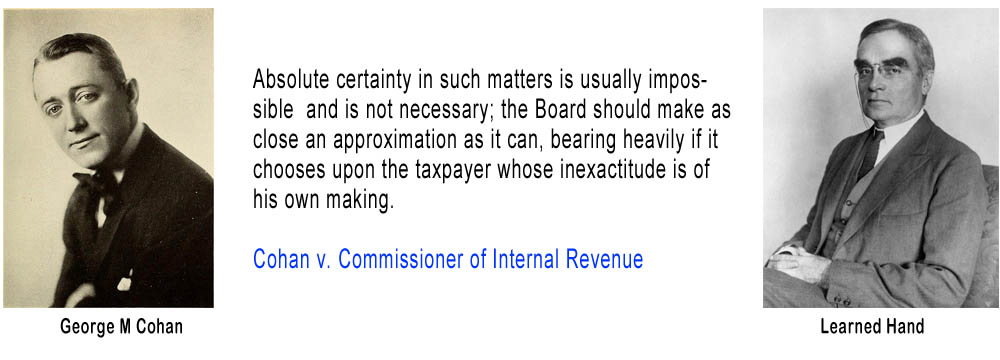

This is a follow-up to a July story about a couple that tried to get a charitable deduction for turning a “tear down” into a “burn down”. What happened is that they bought land with a house on it, but they wanted a different house. Rather than pay to have the house torn down, they invited the local fire department to practice on it. They thought that they were entitled to a charitable deduction for the value of the burned down house. The IRS disagreed and the Tax Court went with the IRS.
The IRS is not satisfied because they don’t think the Tax Court went far enough. The IRS wanted an accuracy related penalty, but the Tax Court ruled:
When petitioners filed their return, the legal issues raised by their charitable contribution deduction claim were not settled. Importantly, in Scharf v. Commissioner, this Court held that a charitable contribution deduction was available for the donation of a building to a volunteer fire department for demolition in firefighter training exercises. The donation in Scharf was made in 1967 before Congress amended section 170 to disallow a charitable contribution deduction for the contribution of a partial interest in property, and the standard applied in Scharf was subsequently superseded by the quid pro quo standard for charitable contribution deductions established by the Supreme Court in Am. Bar Endowment, . No Federal court had reconsidered or questioned Scharf until 2010 when this Court issued Rolfs v. Commissioner, wherein we applied the quid pro quo standard. In Rolfs we held the taxpayers had not made a charitable contribution because they received a substantial benefit in the form of demolition services, the value of which exceeded the value of the interest in the house donated.
Given all the facts and circumstances, including the uncertain state of the law, we find that petitioners acted with reasonable cause and in good faith. Therefore, we hold that they are not liable for any penalty under section 6662.
I really think it is unsporting of the IRS to issue a non-acquiescence in a case that they mostly won, but that is what they have gone and done. I should probably feel good about AOD 2012-05 because it is something of an advertisement for my services. An AOD, which stands for “Action On Decision” is the way that the IRS gives notice of whether it is going to accept a decision as applicable to future cases. The Tax Court let the Patels off because there was uncertainty about the law when they filed their return. The IRS is saying that is not good enough:
We disagree with the court’s conclusion that the uncertain state of the law is a factor that supports a finding of reasonable cause and good faith, without any consideration of taxpayers’ investigation of the contemporaneous state of the law, including their failure to obtain competent professional advice.
Accordingly, the Service will not follow Patel insofar as it holds that the uncertain state of the law, without a finding regarding a taxpayer’s efforts to determine the state of the law, is a factor in determining whether a taxpayer has demonstrated reasonable cause and good faith for purposes of avoiding the accuracy-related penalties.
As noted above, there was another recent case on a deduction for letting firefighters practice on your house. Those taxpayers lost for a different reason than the Patels did. In the Rolfs case it was “quid pro quo”. They wanted the house gone so they could build something else and the fire department helped them achieve that. In that case there was a lot of testimony about how practical it would have been to move the structure someplace else. Patel was based on a legal analysis of the meaning of “partial interest”. The Patel decision would deny the deduction to somebody even if they were not planning on rebuilding.
What the IRS seems to be saying in the AOD is that the Patels were just lucky that the law was uncertain. They were taking a very large deduction that, on its face, had a bit of the “too good to be true” about it. The law was uncertain, but they didn’t prove that they did the research to determine that it was uncertain. The moral of the story seems to be that if you are taking a position that seems like it might be sketchy, you should do the research or have somebody do it for you and document it. Nothing new there really.
You can follow me on twitter @peterreillycpa.
Originally published on Forbes.com Jan 25th, 2013