
















































July 1, 2013
My covivant and I were at the Ephraim Wisler Home on Chambersburg Pike for the unofficial “First Shot” ceremony hosted by David Petruzzi and Steven Stanley and made our way back to the Lutheran Seminary to listen to some cannon fire. We did not stay at the Seminary for the grand opening ceremony of the new museum, though. We had to get to Codori Farm by 9:30 AM for a National Park Service sponsored hike – The Last March of The Iron Brigade.
CV and I had done a program a bit like this at Chancellorsville where rangers led a couple of hundred people on the path that the XI Corps took as it retreated in the face of Stonewall Jackson’s surprise attack. The Last March of the Iron Brigade had the added romance of being a “real time” event. We were about where the Iron Brigade was at 9:30 AM on July 1, 1863 and would follow in their footsteps. In the two hours since Lt. Marcellus Ephraim Jones fired the first shot out on Chambersburg Pike, things have been tough for the gravely outnumbered cavalrymen under John Buford. Help is on the way, though
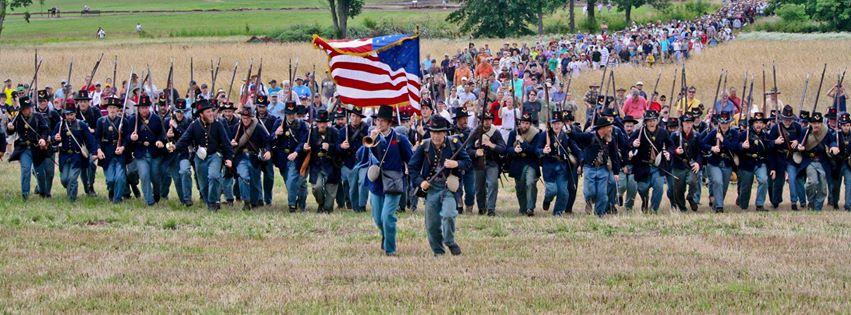
Park historians Scott Hartwig and Dan Welch led the march with the assistance of re-enactors who belong to the Liberty Rifles. This was a big deal for them. According to their website:
The Liberty Rifles has been offered the distinction of being the only reenacting group allowed to do a march on the battlefield during the three-day anniversary. We will be assisting NPS Rangers with their program that follows the footsteps of the Iron Brigade as they entered the field and advanced towards McPherson’s Ridge exactly 150 years prior on July 1st, 1863.
Re-enacting, which requires a significant investment of time and money, is generally done by people with day jobs, making it more of a weekend activity. The really massive re-enacting events for Gettysburg are coming this weekend following some substantial ones this past weekend. Those events take place on private property. On Sunday, we witnessed a pretty good representation of Pickett’s charge with about 10,000 reenactors. As I understand it, reenactors who are allowed to participate in National Park Service events are among the elite in terms of devotion to authenticity.
Reenactors representing 2nd Wisconsin Company H and the color guard of the 19th Indiana were in the vanguard. Reenactors, some in full attire others with just the distinctive “black hats” of the Iron Brigade, (the First Brigade of the First Division of the First Corps) roamed up and down the column keeping order in the ranks. Marching 800 or 900 civilians of every possible description for two miles including crossing some busy roads is a bit of a project. There was also assistance from mounted troopers of the Pennsylvania State Police, which was a nice, but inauthentic, touch.
We were carrying at most small back packs with bottles of water. We were going at a slow pace with several breaks for interpretation and hydration. We were not wearing wool uniforms or carrying muskets. None of us were marching to our deaths. Other than that, it was just like marching with the Iron Brigade exactly 150 years before.
The re-enactors tried their best to keep us in column of fours for safety sake. Having gone to a high school that was organized as a regiment, I was very attuned to this. CV not so much. At one point, I told CV that the soldiers of the Iron Brigade probably did not march to battle holding hands. CV was unmoved and was undisturbed as we shifted among rows of two, three and five despite the re-enactors encouraging us to maintain our ranks.
Ironically, our march along Seminary Ridge took us past the primary Confederate monuments. Our first stop was at the North Carolina monument, which is a real work of art. We were ordered – “If you have water, drink it.” I wisely had brought three bottles. The Park historians mainly told us the stories of individual men like Burlington Cunningham, a color bearer in the 19th Indiana. Being a color bearer was a critical and extremely dangerous role, since the colors were what allowed men to orient themselves to their units in the smoke and confusion of battle.
We marched past the Seminary and up onto McPherson’s Ridge, where the Brigade went into action. They needed to hold the ground for as long as possible to allow the rest of the Army of the Potomac to occupy the high ground south of the town. Although the brigade would continue to exist after Gettysburg, the Park historians called this its last march, because it would never be the same as the brigade that started out in the morning. We marched in the footsteps of 1,883 men. At the end of the battle, only 691 would be left.
Better To Be Lucky Than Good
I had this odd personal connection to the march. At the Chancellorsville sesquicentennial, I had attempted to hunt down the position of my great-grandfather, Private Patrick Lyons, Fifer, Company K, 22nd New Jersey, which was attached to the First Division of the First Corps. The division was only lightly engaged at Chancellorsville and 22nd New Jersey’s position did not even appear on the day by day maps that the Park historians work with. They pointed out some private land and I got as close as possible. I’m not going to say I heard a fife in the distance, but I am not going to say that I did not. Nonetheless, the fate of my family could have been at stake this day were it not far a lucky stroke of fate. Patrick Lyons along with the rest of the 22nd New Jersey mustered out at Trenton on June 22, 1863.
You can follow me on twitter @peterreillycpa.
Trackbacks/Pingbacks