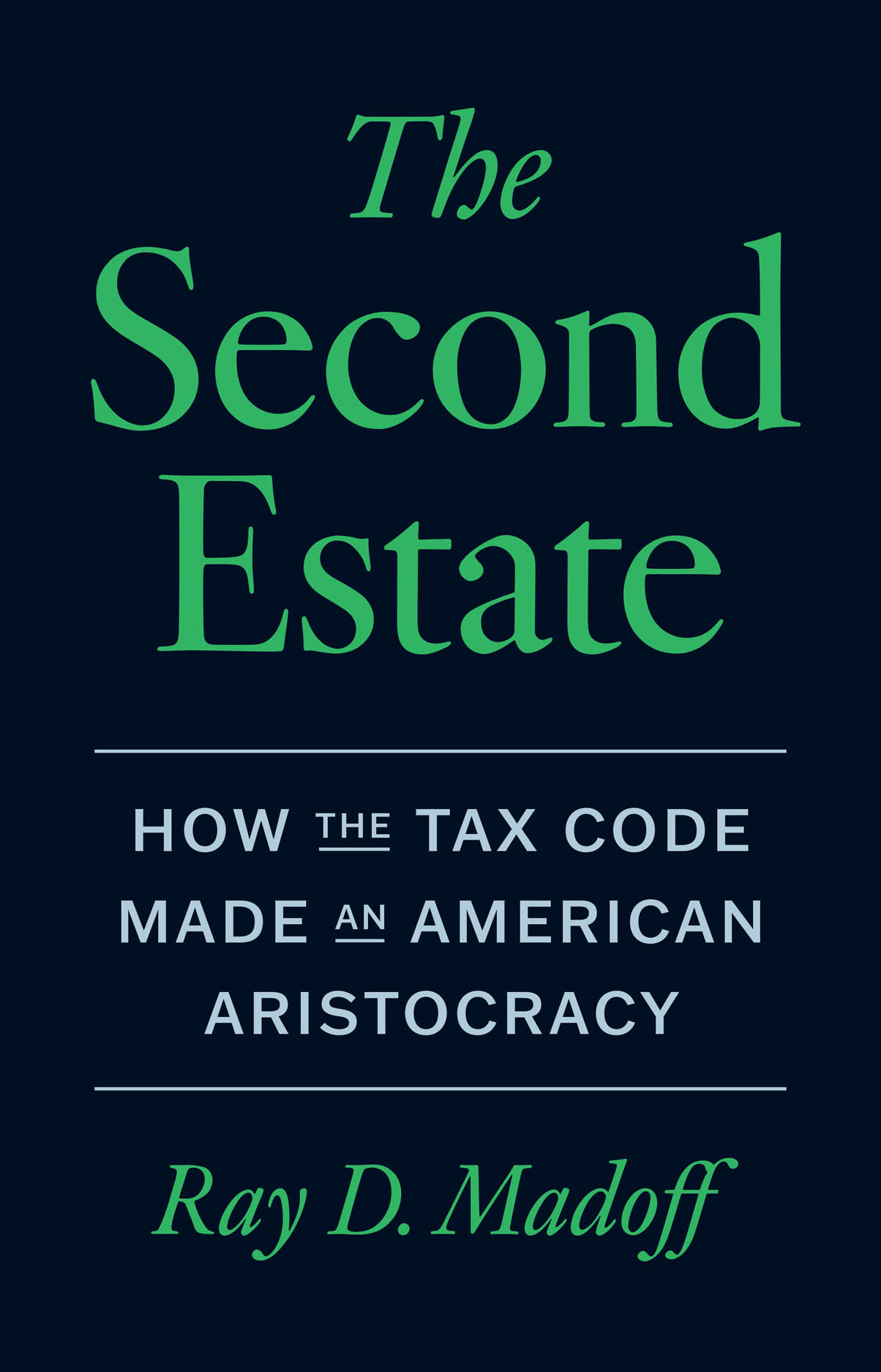
This is something of a review of The Second Estate – How the Tax Code Made an American Aristocracy by Ray Madoff. I pretty much enjoyed the book although I found myself annoyed by some of the seemingly Captain Obvious stuff. In retrospect it dawned on me that the book was not written with tax nerds in mind. It also does not have the perspective that clever ideas to legally avoid taxes are cool things to learn more about. That left me a little frustrated as there was insufficient detail on some of the techniques mentioned. The book is about who pays taxes and who doesn’t pay taxes, how it came to be that way and policy suggestions to make things better.
Who Pays?
Madoff cites an incident in Mitt Romney’s run for President in 2012 where he was recorded telling a crowd of supporters that he couldn’t expect any support from the 47% of the population that pays no income tax. She points out that many of that 47% do pay payroll taxes.
“Because payroll taxes are largely hidden, Congress has been able to increase their reach without much public outcry. Amid near constant pressure over the past fifty years to reduce the burden of taxes, Congress has responded accordingly—and selectively. From 1970 to today, the top income tax rate has fallen from 70 percent to 37 percent, and the top estate and gift tax rate has fallen from 77 percent to 40 percent. Meanwhile, over the same period, payroll taxes imposed on working Americans significantly increased, with tax rates more than doubling from 6.9 percent to 15.3 percent.”
She points out that 12.4% of the 15.3% does not apply to income over $168,600 and goes on the assumption that the incidence of the employer share is actually borne by the employee. And of course none of it including the 2.9% applies to interest, dividend and capital gain income. I would nitpick a bit and point out that on the high end there is the 3.8% net investment income tax which the author does not mention. On the low end and also not mentioned there is the earned income tax credit, a refundable credit that more than offsets payroll taxes at very low income levels.
Much more significant is the analysis of who pays the bulk of the income tax.
“A frequent refrain of those defending the status quo is that the income tax system already heavily burdens the rich because the top 1 percent of earners pay 40 percent of all income taxes while 40 percent of Americans pay no income taxes at all. This is partially true: Individuals with the most taxable income do pay the most income tax. However, this statistic is about people who have high incomes, typically from work; it tells us nothing about the tax liability of those with the most wealth. Studies have shown that there is only about a 50 percent overlap between America’s wealthiest people and those who earn the most income.”
There is reference to the series of stories in ProPublica based on returns leaked by former IRS contractor Charles Littlejohn, who is currently incarcerated. We learn that Michael Bloomberg, Elon Musk, Jeff Bezos, George Soros and Warren Buffett have largely avoided personal income tax by avoiding taxable income. Chapter 2 – The Tax-Avoidance Playbook – discusses some of the means. There are the low salaries of Buffett, Bezos, Zuckerberg and others. Then there are the hedge fund managers paid with carried interests which yields capital gains. Next comes “Buy, Borrow, Die”. Appreciating assets are borrowed against to fund lifestyle rather than being sold deferring capital gains. If they are deferred till death there is a step-up allowing heirs to sell free of tax to pay off the debt. In the deferral area she makes much of companies that have shifted from paying dividends to doing stock buybacks.
The Estate Tax
Madoff traces the history of the estate tax which served as a backstop to the income tax when it came to the wealthy. She sees a shift in the nineties and a long term effort to eliminate the tax, which succeeded briefly in 2010. There was the public relations effort that renamed it the death tax.
“Supporters of repeal had spent millions of dollars in an advertising campaign designed to convince the public that the estate tax—like death—came for everyone (rather than a tiny sliver of the population) and that family farms and businesses were the main targets.”
The most important change in the estate tax that Madoff sees is that since 1990 Congress has not been tweaking the law to counteract clever ideas that planners come up with.
“The names of these workaround techniques read like the secondary characters in a Dr. Seuss book: SLATs, GRATs and GRUTS, CLATs and CLUTs and CRATs and CRUTs, not to mention their cousins, NIMCRUTs and FLIPCRUTs.”
Madoff sees the campaign has having succeeded in a sneaky sort of way.
“For the wealthy heirs of America, this may be the best of both worlds. Although they did not win estate tax repeal, they may have won something better: explicit freedom from income taxes (which is sometimes justified on the basis of the existence of the estate tax), as well as a seemingly hidden freedom from estate taxes (which they can now achieve through some of the many available estate-planning techniques ignored by Congress).“
Charity Begins At Home And Often Ends There
There is a pretty lengthy explanation, which I found a bit tedious, of how it is that regular people don’t generally get any tax benefit from charitable contributions. Apparently many are not aware of this. Then there is the benefit the wealthy might get. The number was 74%, which I didn’t quite get. It is explained in a footnote and comes from adding the value of the income tax deduction to avoided capital gains and estate tax.
Madoff is further concerned about the delay in any public benefit from charitable donations by the wealthy as they can end up warehoused in private foundations and donor advised funds.
Recommendations
Madoff recommends three steps to improve things. The first is to repeal the estate and gift tax, which are broken and unfixable. Next is to repeal the income tax exclusion for inheritance and gifts and tax unrealized gains at death. She also calls for meaningful payout requirements on donor advised funds.
Overall Evaluation
The book was a pretty easy read, which accounts for some of my nitpicking. The provocative proposal to eliminate the estate tax while subjecting inheritance and gifts to income tax is intriguing. I’m slightly annoyed that at the Kindle price of $23.75, a few cents more than the hardcover, but the value is there.
I also appreciated the historic discussion. The “Second Estate” in the title is a reference to the pre-Revolution French aristocrats who were pretty much exempt from all taxes. Of course you and I knew that, but you have to consider the other readers.
Other Coverage
I found out about the book from Paul Streckfus’s EO Tax Journal 2025-172. When it comes to donor advised funds, don’t get him started. He wrote:
“I confess Professor Ray Madoff is one of my favorite people. She is out with a new book, The Second Estate: How the Tax Code Made an American Aristocracy. I’m reprinting the promo for the book below. What I’ve learned over the years is that the tax code is all about making wealthy people wealthier. Their hope is that the W-2 crowd doesn’t wake up to this reality (they probably know they are victims but can’t do anything about it). We now live in two societies: the well-to-do and everyone else. Ironically the nonprofit sector mostly benefits the well-to-do. Take section 170, who mostly benefits? Take DAFs, who mostly benefits? While most charitable institutions provide some public benefit, the reality is that private benefit and yes, inurement, exist and often benefit the well-to-do. At one time we had a regulator in the IRS, but those days are long gone. The average person is not stupid in wondering why there is so much wealth for the few while the majority of people are stuck in quicksand.”
Ben Gose has How the Rich Use Philanthropy to Dodge Taxes in the Chronicle of Philanthropy October 23, 2025. It is an interview with Professor Madoff.
The Chasing Leviathan Podcast has The Second Estate: How the Tax Code Made an American Aristocracy with Ray Madoff. It is a one hour interview and pretty well gives you the gist. Be sure to check out the comments.
One of the reasons I found the book so delightful is that I actually once advocated eliminating both the estate and gift tax and the income tax exclusion for gifts and inheritance. Here is my Tax Simplification Proposal. The beauty of it is that it takes a large chunk out of the Code.
Originally published on Forbes.com.
For great value continuing professional education. I recommend the Boston Tax Institute
You can register on-line or reach them by phone (561) 268-2269 or email vc@bostontaxinstitute.com. Mention Your Tax Matters Partner if you contact them.
For articles oriented toward tax professionals check out Think Outside The Tax Box.

————————————————————————————————————————