



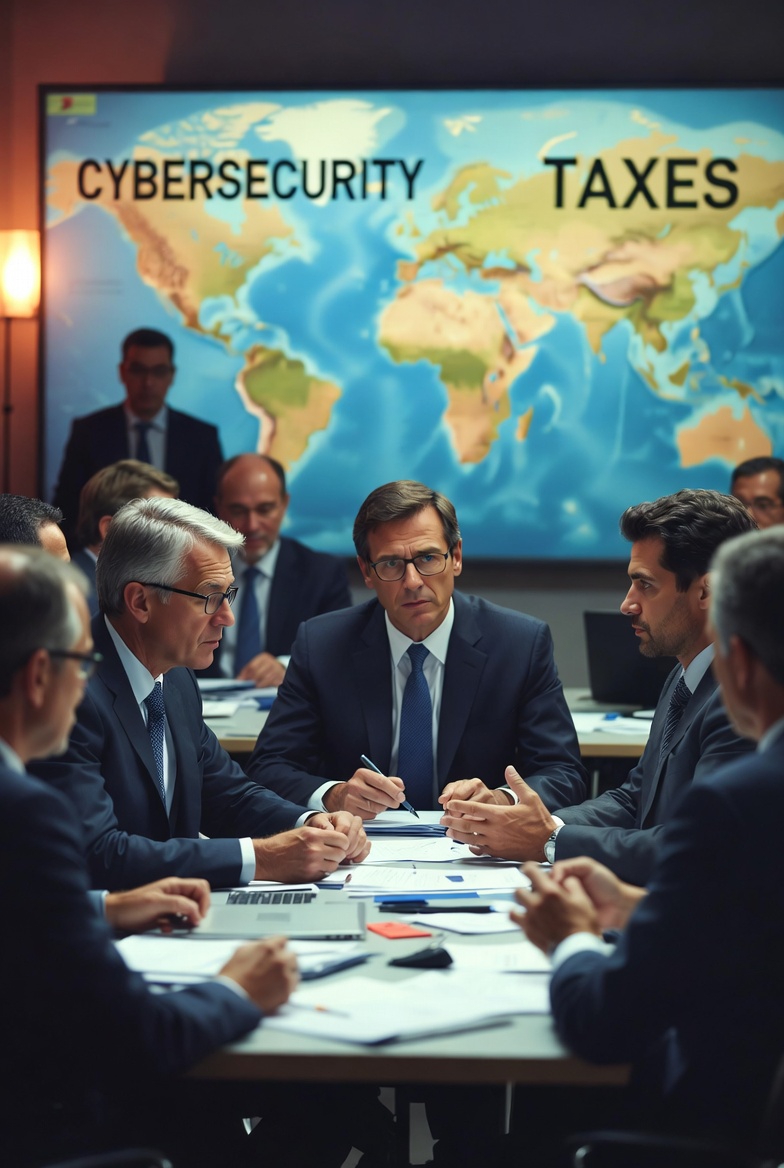
Image by Grok
Nothing reinforces my identity as a journalist so much as getting the release of a story that is embargoed. They are trusting me to not post on it until a certain amount of time has passed, but the access allows me to study the material. The ideal thing would be to have a brilliant piece that I post an instant after the embargo is lifted. With a much longer time horizon, that is how New York Times obituaries work. They have biographies pretty fleshed out years in advance. They haven’t come to interview me yet, but I am only 73 going on 74 and in good health so I am sure they will be calling me in the next couple of years.
Anyway, it makes it a little embarrassing that here I am the day after the embargo has been lifted still working on something. Here is the story.
Global Disputes Forecast
The almost breaking story is about Baker McKenzie’s annual Global Disputes Forecast. The report is based on a survey of 600 senior decision-makers with key roles in disputes and investigations in organizations with revenue greater than half a billion dollars. Sunny Mann, Global Chair of Baker McKenzie summed up the situation as follows:
“We find ourselves in a paradox. Organizations are more globally connected than ever, yet operating in an increasingly fragmented and unpredictable geopolitical environment that is fundamentally altering risk calculations.
The challenge for multinationals is that global integration, once seen as a hedge against risk, has become a vulnerability: supply chains cross contested borders, data flows encounter sovereignty barriers and business relationships can become compliance liabilities overnight as political alignments shift.
A primary mitigation technique among our clients is one of diversification across supply chains, customer base, funds flows, data storage and business and investment partners. Overreliance on a single party or market is a vulnerability.”
I was impressed to find that Mr. Mann came from a very modest background. His father was a factory worker and his mother a seamstress.
What Worries The Global Business Elite?
The four most troubling types of disputes the leaders were concerned about were cybersecurity, tax, trade sanctions and ESG (environmental, social governance). When it came to investigations, the top four concerns were cybersecurity, tax, fraud in many forms, and ESG tied with financial accounting and reporting. The concern about tax has risen by 5% from the survey released in 2025.
My own very limited exposure to the international arena makes me really feel for these guys. Every time I got involved in what I called “foreign stuff”, it was a nightmare. It is a possible comfort that the top guy in one of the major advisory groups might have some feelings for the little people.
Because of my generally parochial nature I found it difficult to evaluate the report that well. So I asked my friend Grok for his thoughts. (I don’t know why I think of Grok as male, but so it goes.)
“Overall, the Global Disputes Forecast 2026 is a solid, insightful resource for navigating a complex year, particularly for professionals in tax and compliance like yourself in Massachusetts. It substantiates claims with survey data and encourages preparation, but treat it as one perspective in a broader strategy—cross-reference with independent sources like government reports or academic studies to mitigate any firm-specific slant. If you’re focusing on tax disputes, the Pillar Two emphasis rings true based on ongoing global implementations, but actual impacts will depend on jurisdictional enforcement,”
OK. But what does it mean for us little people. Grok had a pretty long answer for that, but here is the takeaway.
“For those centered on small businesses and individuals, the report’s importance lies in its big-picture warnings as a “canary in the coal mine.” Trends starting at the global level often filter down—e.g., a cyber incident at a major retailer could expose small vendors or consumers. It can inform scaled-down strategies: encouraging small business owners to build basic resilience (e.g., via local chambers of commerce) or helping individuals avoid common pitfalls in tax filings amid regulatory flux. However, its corporate focus means it’s not a perfect fit; you’d want to supplement with resources like IRS small business guides or state-specific advisories for Massachusetts.
If you’re advising clients, this could spark discussions on risk assessments—e.g., “How exposed is your supply chain to trade wars?”—potentially positioning you as a forward-thinking CPA. “
More About Baker McKenzie
Baker McKenzie is one of the largest law firms in the world. According to this report they are number 4 and according to this one they are number 9 with over 4,500 lawyers and $3.39 billion of revenue. They started in Chicago in 1925 or 1949, depending on how you look at it, and have been international since 1955. When founder Russell Baker (not the columnist) died in 1979, they were at 450 lawyers.
Like any institution that has been around for a hundred years, they’ve got some baggage. They showed up in the Pandora Papers quite a bit. And there is this Tom Hanks movie that is likely based on how they treated one of their attorneys back in the eighties. You can figure out that one on your own if you want to watch some clips. I don’t mean to knock them just want you to know I am paying attention.
You can find my most practical advice along with a lot of other great stuff at Think Outside The Tax Box.
For great value in continuing professional education check out the Boston Tax Institute.