Originally Published on forbes.com on August 19th, 2011
______________________________________
In the minds of some, the most despicable current beneficiaries of legally proper, but morally reprehensible tax benefits are hedge fund managers. I have never seen a hedge fund manager at work. I’m going to speculate here and guess that if I could become invisible and follow one around during a typical work day I would observe someone hunched over a computer working the keyboard and the mouse, talking on the telephone, going to lunch with people, reading reports, speaking with people who come into the office, attending meetings. In other words it would be a lot like following myself around all day. Only the hedge fund manager would be wearing a better suit. So why does the hedge fund manager get capital gains treatment on much of the manager’s earnings without having to invest any money or guarantee any debt? I on the other hand have to invest money and guarantee debt and all my income is ordinary and subject to self-employment tax. That’s what bugs people about hedge fund managers. Well it bugs a lot of people. It doesn’t bug me. There are two reasons it doesn’t bug me.
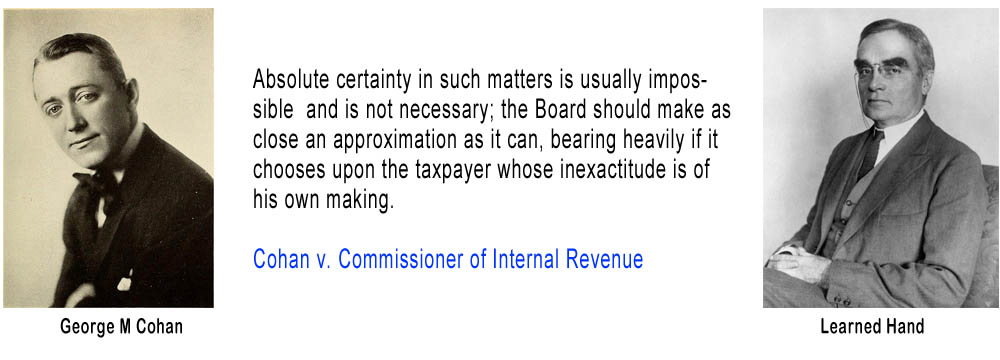
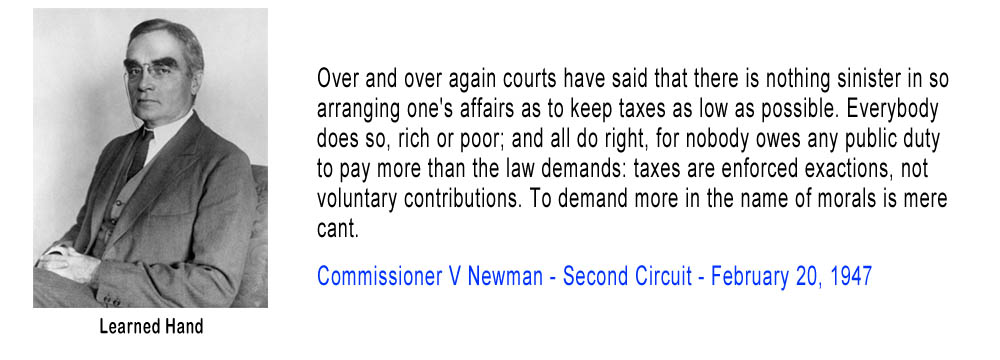
The first reason is the quotation from Learned Hand that was the anthem of the tax shelter industry in the 80’s and is featured prominently on my
old blog:
Over and over again courts have said that there is nothing sinister in so arranging one’s affairs as to keep taxes as low as possible. Everybody does so, rich or poor; and all do right, for nobody owes any public duty to pay more than the law demands: taxes are enforced exactions, not voluntary contributions. To demand more in the name of morals is mere cant.
This tolerant attitude on my part does not extend to shenanigans like those that
Richard Eagan’s advisers devised. I’m way too attached to double entry. The hedge fund managers are not doing that though. They are engaging in real transactions and their advisers are positioning them in the most favorable manner. The Tax Court noted that distinction in FlextronicsAmerica, LLC v. Commissioner, TC Memo 2010-245 :
Respondent emphasizes KPMG’s role with respect to the inventory transactions. Certainly Canadian Parent and KPMG contemplated different ways to bolster the appearance of a business purpose relating to the inventory transactions. There is no doubt KPMG fervently encouraged the use of the planning technique. Receiving KPMG’s advice did not, however, nullify petitioner’s bona fide business purposes for the transactions.
KPMG was simply advising a client on different ways to minimize the tax consequences of a proposed transaction—precisely what tax accountants are paid to do. The second reason that what the hedge fund managers are doing doesn’t bother me is that it involves a very elementary principle of partnership taxation. You won’t find “hedge fund” or “carried interest” in the Code. Hedge funds are partnerships and the managers are among the partners in them.
Although a partnership does not pay taxes, it is a “taxpayer”. What that means is that it computes its taxable income based on its own accounting methods and elections. Determinations are made based on what the partnership does. For example, none of the partners might be traders in securities but the partnership might be.
All of the income and deductions and tax preference and credits are determined at the partnership level. Then all of them are allocated among the partners. There are complicated regulations (Here is a link to the table of contents. Just to give you the flavor) about how the allocations need to be done. The fundamental principle is very simple. If we were to sell everything and split up the money would the allocations of income and deductions give you a capital balance equal to the money you were about to receive? As a matter of fact that is how contemporary partnership agreements are written, because early attempts to apply those regulations to real life ended up creating economic distortions. So if the partnership had $100,000 in long term capital gain, it is all going to get allocated to somebody.The hedge fund manager rather than (Well it’s actually in addition to, but I’m trying to keep things simple here) taking a fee gets a share of the gain. Could you get to the same economics a different way ? Yes. Don’t admit the manager to the partnership and pay a perfomance fee instead. Then the manager would have ordinary income. The investors though would have a larger capital gain and a deduction. So the amount of capital gain being taxed at a favorable rate is no different.
Does the treasury come out behind on the deal ? Probably. Under the fee method the manager’s ordinary income is equal to the investor’s deduction. The total amount of favorably taxed capital is the same. It seems like a wash. Let’s go on the likely assumption that the manager has a salary of at least the FICA limit ($106,800) without the performance fee. The manager is beating 2.9% in medicare tax – not that big a deal. What happens to the investor ? Instead of a capital gain of $80,000 under the “carried interest” method, the investor might have a $100,000 capital gain and a $20,000 deduction. That could put the investor ahead by the same amount that the manager went behind in computing income tax. The problem for an individual investor is that the deduction is subject to a 2% floor and not deductible against alternative minimum tax. Also adjusted gross income will be higher, which might affect other computations. Of course if the investor is a C corporation or an exempt entity, the change will likely be indifferent. So carried interest might put the treasury behind, but not for the reason people seem to think. The total amount of sometimes favorably taxed capital gain is no different from one method to the other when you add everybody up.
Part 2 is going to discuss the proposal to fix this perceived problem. I’m going to close with two questions to ponder. Is there some reason that hedge fund managers should be treated differently from everybdy else ? Can the perceived problem be fixed without making life difficult for other pa