
Real Estate Investment Trusts, Publicly Traded Partnerships And The 20% Business Deduction
Real Estate Investment Trusts (REIT) and Publicly Traded Partnerships (PTP) get special treatment in the Tax Cuts And Jobs Act (TCJA)- Sorry I just can’t call it tax reform. Maybe tax deform, but that sounds silly. TCJA repealed Section 199, a kind of freebie 9% deduction, that created a frenzy of gaming in somewhat limited circles – Brewing coffee is manufacturing. I mean who knew? -and replaced it with a much broader 20% deduction (Section 199A). To qualify for the deduction your trade or business has to be paying people W-2 wages or have depreciable assets if your taxable income exceeds a threshold. REIT dividends and PTP flow-through income get the 20% deduction with no strings.
Senate Snuck A Tax Break For Subsidy Farmers Into Tax Cuts And Jobs Act
But where is the break for subsidy farmers? In adding 461(l), the Act suspends 461(j). Section 469(j) was a hoop that is between at-risk and passive activities, that I ignored in my original analysis. I could say that I ignored it, because it is not generally applicable, but that would be lying. I ignored it because it was not something I knew about. Not a lot of amber waves of grain in Central Massachusetts. Anyway if you are getting any of a variety of agricultural subsidies that our hardy self-reliant farmers might get and like old Calhoun there still manage to lose money farming, 461(j) limits your loss and kicks it into the next year in a manner similar to 469.
The threshold is the greater of $300,000 or the aggregate net farming profits in the last five years. Under 461(j), Calhoun in both of the scenarios above would have $700,000 of his farm loss suspended. So being subject to 461(l) is a somewhat better deal for the salaried Calhoun and a home run for the one with the dealerships.
Follow Me
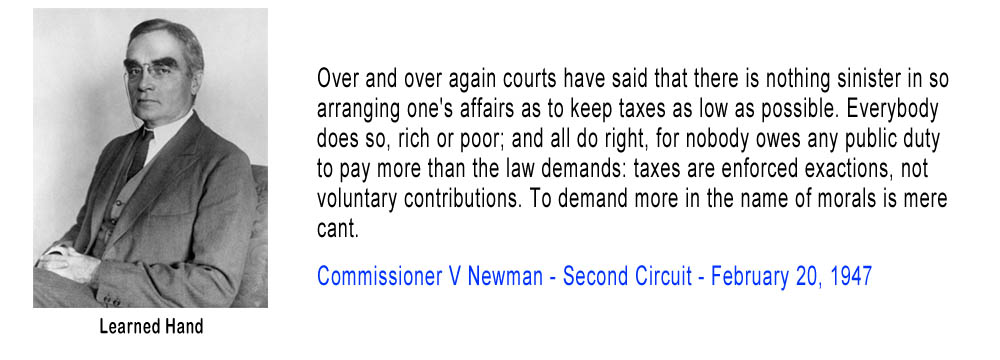
Over and over again courts have said that there is nothing sinister in so arranging one’s affairs as to keep taxes as low as possible. Everybody does so, rich or poor; and all do right, for nobody owes any public duty to pay more than the law demands: taxes are enforced exactions, not voluntary contributions. To demand more in the name of morals is mere cant.
