






















American Living In Canada Loses First Round In Fight Against Harsh IRS Penalty
Form 5471 is titled Information Return of U.S. Persons With Respect To Certain Foreign Corporations. It makes it sound like Mr. Dewees was into really big stuff, but that was not the case. Mark Feigenbaum, the attorney, gave me a short course in Canadian tax planning. The corporate rate is much lower than the individual and there is relief from double taxation. So you can get a significant deferral by trapping income in a corporation. Because of that lots of very small businesses that would be flow-through entities or disregarded in the US are organized as corporations in Canada. Besides his employment income, Mr. Dewees had some side consulting income. He used a corporation for the consulting income because that is what a lot of people do in Canada.
Grandparents Lose Tax Benefits To Daughter’s Common-Law Marriage
A lot of the complexity of the income tax is inherent in trying to tax income, but that sort of complexity does not really impact regular people all that much. You are probably not running a bank or a life insurance company, maintaining inventories or mining. Some of the complexity introduced by using the income tax as the Swiss utility knife of social policy also does not create complexity that regular people have to deal with. You are probably not developing affordable housing, preserving historic buildings or building golf courses, because you feel so strongly about conservation as seems to be the case with President Trump.
The complexity introduced by using the income tax code to subsidize the working poor, or perhaps their low-wage employers, does impact ordinary people who end up having to pay to have income tax returns prepared that really could otherwise be on a postcard. And it sucks up a good bit of scarce compliance resources and involves the IRS in sorting out matters that would be better handled by social workers rather than accountants.
Follow Me
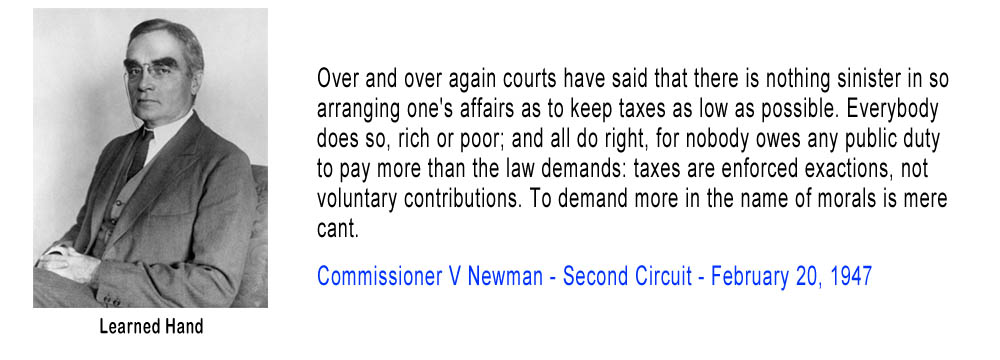
Over and over again courts have said that there is nothing sinister in so arranging one’s affairs as to keep taxes as low as possible. Everybody does so, rich or poor; and all do right, for nobody owes any public duty to pay more than the law demands: taxes are enforced exactions, not voluntary contributions. To demand more in the name of morals is mere cant.
