












Kent Hovind Remains In Custody – Judge Would Have Ruled Against Motion To Dismiss
People who have been following the Kent Hovind trial were taken by surprise this weekend as the federal government moved to drop, without prejudice, the remaining charges against Hovind and Hansen (In March they were convicted on charges of contempt of court, but the jury did not reach a verdict on more serious fraud and conspiracy charges. Jury selection for retrial on those charges was scheduled to begin this morning.)
More or less at the eleventh hour, the United States Justice Foundation assisted Hovind’s attorney Thomas Keith and Hansen, who is pro se on this round, in submitting a motion to have the charges dropped. The United States requested a continuance to respond to the motion. Judge Rodgers indicated that she was not inclined to grant a continuance and scheduled oral arguments on the motions this morning with jury selection to follow, if the motions were not allowed. Then came the big surprise. The United States moved to dismiss the remaining charges without prejudice. (Meaning, as I understand it, that the charges can be refiled).
Entrepreneurial Cardiologist Denied Real Estate Pro Status By Tax Court
One of my mentors in public accountant once gave me some advice about the lease or buy issue. It is dated, because back in the day there was an investment credit. He said he once went through the analysis in depth considering all the factors. After that whenever a client called him to ask about a lease buy decision, he would tell him to buy and charge him a hundred dollars. (Back in the day a hundred dollars, was , you know, a hundred dollars.) When you lease you get to deduct whatever you pay throughout the term of the lease. When you buy you take depreciation deductions over the life of the property and deduct the interest payments as they occur. You don’t deduct the principal payments (Although you do in a sense, because of your depreciation deductions). It ends up being about timing.
Follow Me
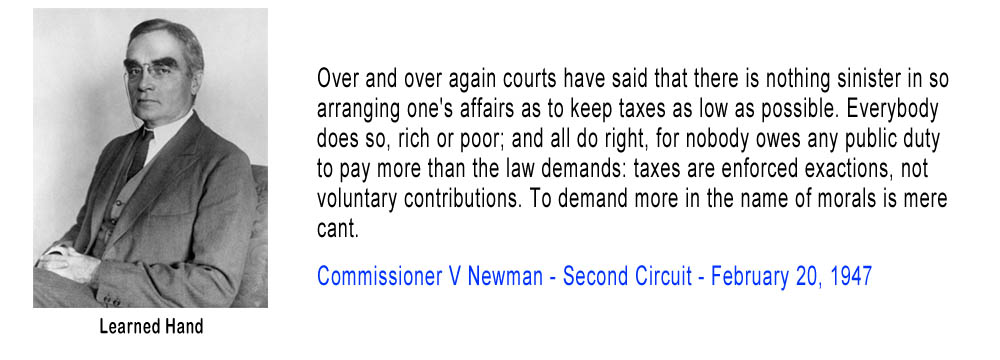
Over and over again courts have said that there is nothing sinister in so arranging one’s affairs as to keep taxes as low as possible. Everybody does so, rich or poor; and all do right, for nobody owes any public duty to pay more than the law demands: taxes are enforced exactions, not voluntary contributions. To demand more in the name of morals is mere cant.
