

























































Repair Regs – A Hellish Tax Season And Refunds Of Biblical Magnitude
The new regulations force accountants to lift up their eyes from the invoices and look at the actual building. Much of the teaching in the regulations is done by example. Besides the basic structure there are eight separate units to consider as part of a building. One of them is heating, ventilation and cooling. Consider two buildings. One has 10 roof-mounted HVAC units. The other has a single chiller unit. If you replaced four of the 10 roof units or the single chiller unit, you will get a whopping big bill, which you would either expense or capitalize depending on how aggressive you are. What the regs say is that you can probably expense the four roof mounted units, but definitely have to capitalize the single chiller.
Here is where accounting method changes come in for some big money. Suppose that four years ago you spent, to make the math easy, $390,000 on items which you capitalize (and of course to make the math easy placed in service on January 1). It is too late to amend that return, but with an accounting method change you get to write off the $350,000 that remains undepreciated in 2014. That’s what people are excited about. Of course, it is more likely to be a help to the owners of large buildings who might have capitalized the replacement of 10 out of 100 elevators six years ago. Small time landlords who own buildings with just one of everything are not going to have even proportional adjustments.
Restoring Trust In IRS Is A National Imperative
Prior to the reorganization the IRS was organized into 33 geographic districts, each headed by a district director who typically had extensive field experience. This structure was replaced with a “stove pipe” structure. The effect of the structure is to have people reporting to management in far away offices, often in Washington. The stove pipe means that information only goes up and down with no local coordination. Also it has also been considered not so necessary for senior executives to have any field experience or knowledge of tax administration. Case in point is one Lois Lerner, who came from the Federal Election Commission and based on her priorities thought that she was still working at FEC while head of the IRS Exempt Division
Follow Me
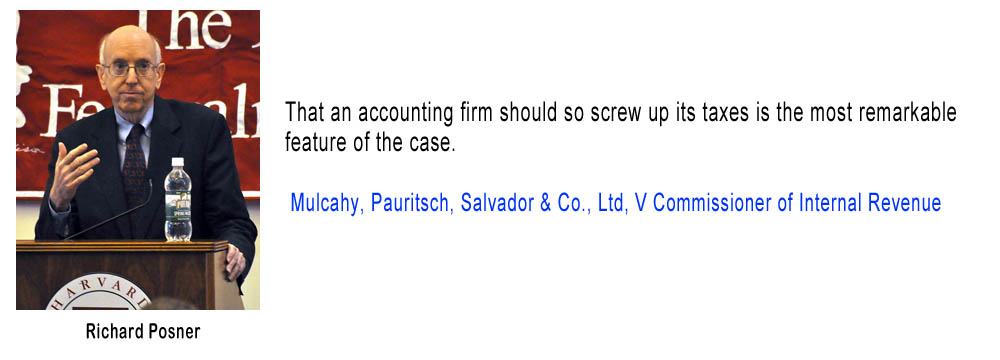
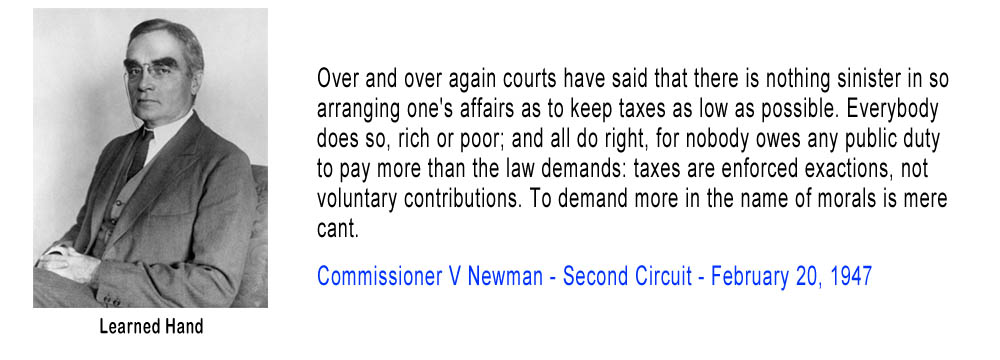
Over and over again courts have said that there is nothing sinister in so arranging one’s affairs as to keep taxes as low as possible. Everybody does so, rich or poor; and all do right, for nobody owes any public duty to pay more than the law demands: taxes are enforced exactions, not voluntary contributions. To demand more in the name of morals is mere cant.