







































Most Recent Posts
Where Are Jill Stein’s Tax Returns?
If Dr. Stein inherited anything other than an interest in a socially responsible organic zero energy health food store, there will be somebody on the floor at the Green Party convention asking why she doesn’t give it up
Beer For Rudy’s Horses
One of the things that other Hovindologists, the small band interested in the Kent Hovind chronicle, who are not supporters of Dr. Dino, find odd about me is my...

EPI Economists Argue That Financial Transaction Tax Is Win Win For Economy
The latter observation reminds me of a game I used to play. You were the ruler of a country and you decided how much seed to plant and how much to feed people. You could also buy and sell land and grain. After playing the game for a while I concluded that planting and harvesting were a waste of time. You could win by focusing on land and grain speculation. And I just let my peasants eat cake.

Saga Of An Entrepreneurial Family Catching A Tough IRS Audit
The core of the McMinn empire was the embroidery machine business. They find embroidery machines, buy them, refurbish them and sell them. Quite a few go to Mexico. They also capitalize on their expertise in knowing how to move these machines around. It is a profitable business. There is more than one entity involved and I am going to gloss over those details. Read the case if you are interested.
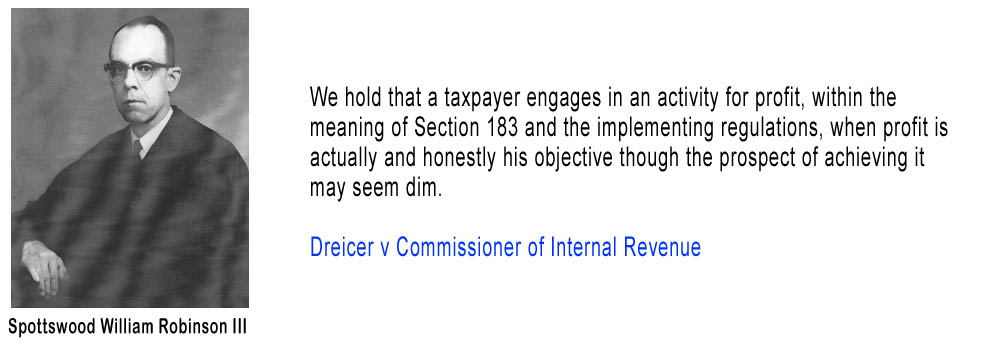
Then there was the cattle business, which did not do too well, so they were converting that to deer ranching. And the resort. Not to mention the juice business. Juice Plus. a multi-level marketing operation. The McMinns ended up getting hammered on three issues, Section 183, the so-called hobby loss rules, wages that they paid their numerous children, and substantiation. The substantiation piece is the most important lesson that the decision holds for us. If you have mixed personal and business use of expensive assets, keep logs.
The Guardian Seeks Transparency In Amazon Tax Court Case
Guardian has not cited, and our own research has not discovered, any instance in which this Court, or any other court, has been asked to decide whether a media organization should be allowed to intervene in a pending Federal tax controversy. Guardian’s motion presents novel questions, both as to the proper standards for intervention in the absence of any Rule governing the subject, and as to whether the IRS, as an agency of the United States, adequately represents Guardian’s interest in public disclosure.
A Very Broad Transaction Tax Might Have Merit
Thanks to the reckless greed of Wall Street over the past few decades, the American economy is a grossly unbalanced playing field.The only way we can level it is if we rein in reckless speculative financial trading and curb near-instantaneous high-volume trades that create instability in the stock market and our national economy. These financial practices have no intrinsic value, and exist to make a quick buck for already-wealthy speculators. If we want to give middle-class families a fair shot at a strong economy that works for all Americans, we need to put Main Street FIRST.

Nevada Corporation Exists Under IRS Name For Decades
So that’s that, which brings us to the interesting part. How long was there a Nevada corporation called – Department of Treasury – Internal Revenue Service? Over 20 years. DT-IRS was formed in 1994. As far as I can tell, it has not been wreaking havoc during that time. Early on AR Salman sued the actual IRS for using its name, which thanks to the registration he owned. He was looking for $900,000. What he got instead was a ruling that he was a “vexatious litigant”. That particular case was not Salman’s first tax protester rodeo.
Facebook, Leprechauns And The Cayman Pot Of Gold
Until this month even a close follower of the news might be hard-pressed to name more than two people famous for having worked for the IRS. Of course, John Koskinen and Lois Lerner have been made famous by Congressional investigation rather than from doing their jobs. Now there is a third. Nina Wu Stone is a Revenue Agent for the Large Business and International Division of the IRS. And it is her declaration that is attached to the summonses to Facebook filed by the United States in the District Court for the Northern District of California.
How To Not Get A Deduction For Paying Your Girlfriend’s Mortgage
Sadly, Mr. Jackson did not really have much of that going on. He claimed that he gave Ms. Furney $1,000 in cash each month. Nonetheless, he deducted $15,720 in mortgage interest in both 2011 and 2012. That’s a pretty hefty deduction given that he had wage income of $39,292 and $33,022 in those two years. The Form 1098, which was as you would expect addressed to Ms. Furney showed $13,794 in each year. So the $15,720 appears to be what my first managing partner, Herb Cohan, would refer to as “You know. A figure.”
Restoring Fifties Plymouths Ruled Business Not Hobby By Tax Court
The critical element, in my view, is adjusting your behavior as you see that things are not working. You will see people who win horse cases on the same grounds. Amway Independent Business Owners on the other hand always seem to keep on keeping on in the face of persistent losses.
Mr. Main did not avoid the common problem of attorneys in Tax Court. He lost some of his deduction for lack of substantiation. That was the story of the great F. Lee Bailey, who is now filing for bankruptcy. He won against the IRS on a highly technical issue and split with them on hobby loss, but got absolutely killed when it came to substantiation. Mr. Main, on the other hand, seems to have only given a bit on that issue.