











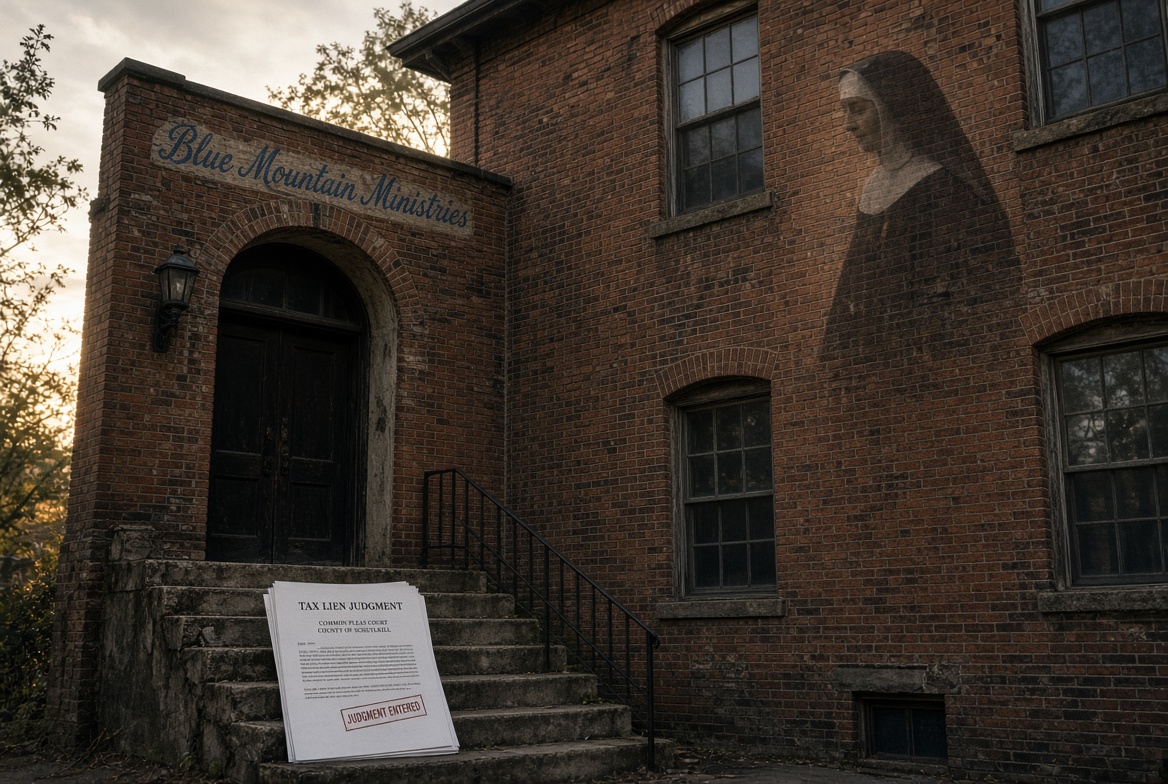
Image by Grok – not a picture of actual building
As best as I can tell nobody else is paying attention to the United States of America v John M. Kistler, et al. I picked up a July memorandum order by Judge Julia K. Munley of the United States District Court for the Middle District of Pennsylvania. I was just going to give it a brief mention in the round-up, but I decided it deserves the full treatment. It is a fascinating story. The government was seeking to foreclose federal tax liens and a judgement lien against parcels of real estate located at 65 and 69 Tompkins Street Pittston PA to collect tax judgements they had obtained against Mr. Kistler. Mr. Kistler had a plentitude of objections and counterclaims for Judge Munley to mull over. The parcels add an interesting element to the story.
About The Parcels
The parcels are part of the property that used to be Saint Rocco’s Catholic parish. The church was built in 1920 to serve the Italian immigrant community and staffed by priests of the Oblates of St. Joseph, who have a seminary in Pittston. A school was opened in 1946 staffed by the Religious Sisters of St. Lucy Filippini. The school, closed in 1971, later housing Luzerne County Head Start. In 2009 the Diocese of Scranton announced consolidation with nearby Our Lady of Mount Carmel, another Italian parish long served by the Oblates. The final Mass at St. Rocco’s was celebrated July 1, 2012.
In 2015 the Saint Rocco’s church building was sold for $70,000 and it became the St. Irene Russian Orthodox parish. That operation proved to be pretty transitory. Bishop Ramzi Musallam who managed the acquisition has had an interesting after story, but that is a rabbit hole too many for this story. You can read about it here.
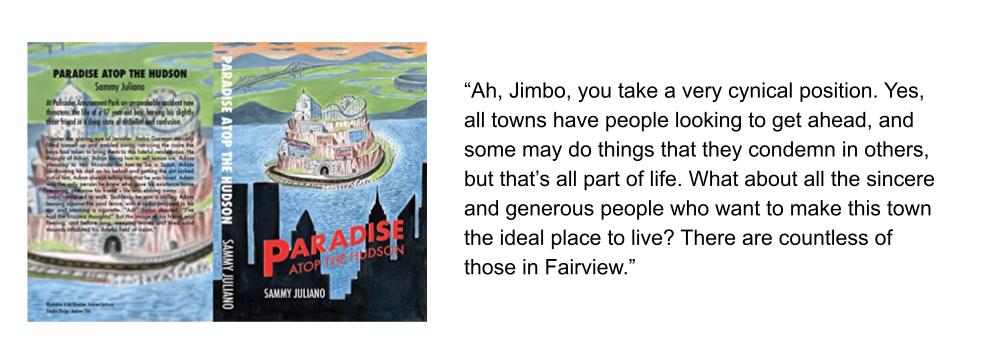
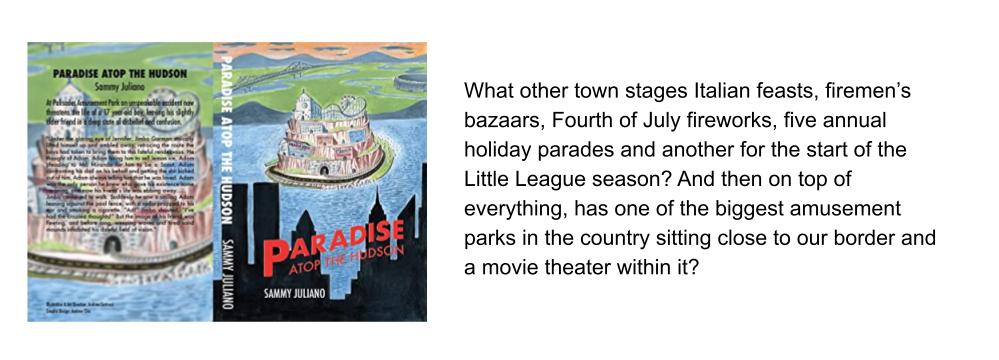
The merging away of Saint Rocco’s is understandable. When the church was built in 1920, according to the census, Pittston’s population hit its peak of 18,497. Population has declined in every subsequent census reaching 7,591 in 2020. Still there is a sadness to it. I grew up a short walk from my town’s “Italian church”, Our Lady of Grace staffed by Pallotine fathers, just blocks from the parish church St. John’s. OLG is still there. Novelist, Sammy Juliano explored the significance of the ethnic parish in his Fairview NJ novel, Paradise Atop The Hudson.
The other parcels, which are more germane to our story, were bought by Blue Mountain Ministry, LLC for $90,000. According to this story in the September 17, 2015 edition of the Times Leader,
“a Blue Mountain Ministry spokesman who would identify himself only as “Pastor John,” the non-profit organization was established in 1997 as a travelling ministry based out of Lehighton. From that time until now, it was comprised of Christian ministers of the Methodist faith who spoke at various churches around NEPA, filling in for other ministers who were sick or on vacation. The purpose of the newly-purchased property is to put down roots in a permanent location.”
65 Tompkins Street is the school building which as of April 2023 was still labeled a school. Process of elimination makes 69 Tompkins Street the former convent. If you zoom in a bit, you will see “Blue Mountain Ministries” in blue cursive on the door.
According to the government’s position Blue Mountain Ministry is an alter ego of John M. Kistler. In his filing, John-Michael-Jr.; of the Family Kistler, “Flesh and bone human being Beneficiary” has C/O 69 Tompkins Street as his address. In one of its filings the government asserts that Mr. Kistler is living in the convent. That adds a touch of color to the story, particularly if you were brought up Catholic. What is really interesting about Kistler are his views on taxation.
Not Conventionally Tax Compliant
I refer to people like myself who believe that Americans with more than insubstantial income are required to file income tax returns and pay the the balance due if any and act accordingly as “conventionally tax compliant” (CTC). People who think otherwise, I call “alternative tax thinkers” (ATT). People who act on those beliefs I call not conventionally tax compliant (NCTC).
John Kistler clearly falls in the NCTC category, but before we get into that we can take a quick look at the government’s. In previous litigation the government got an order reducing to judgement Kistler’s liability for the years 2008 through 2012. The total tax for those five years was $42,394. The Abstract of Judgement Notice issue November 1, 2023, which included interest and penalties through June 6, 2022, was for $81,858.
Kistler has a plentitude of arguments for the court to deal with. To get a feel for all this take a look at his Response To A Summons In Civil Action filed June 4, 2025. It starts with how the document is headed. The United States of America is the “Alleged Plaintiff”. John M. Kistler Jr. et al is “A corporate fictional / Alleged Defendant”. Then there is a notice that this is and administrative trust action and a $10 million dollar countersuit for defamation of character and continued harassment for over 25 years. And as noted above he is John-Michael-Jr.; of the Family Kistler, “Flesh and bone human being Beneficiary” .
He goes on to provide warnings to the judge and explains that he is not a citizen. He indicates that he will gladly file any 1040s when he is provided with specific points of law that require him to comply with the Internal Revenue Code. After all its own literature seeks to encourage voluntary compliance. He makes it clear he is not volunteering. There is a lot more including some handwritten forms that are supposed to settle everything.
There is another response that runs even longer also filed on June 4, 2025. A lot of it I don’t really get. On page 9, we learn that the IRS is a collection agency working for foreign banks and operating out of Puerto Rico. There is more.
I decided to ask Grok to do an analysis of those two documents along with a sort of fee schedule that he filed in December 2025. I wanted to get a sense if any of the well-known alternative tax thinkers were influencing his work. I was a little disappointed with the result, but you can make your own judgement. Here is the round-up:
“No single living celebrity protester is named in the visible pages, but the documents are assembled almost entirely from the standard toolkit that has circulated in tax-protester and sovereign-citizen circles for 25–40 years. The combination of the identity theory, the redemption paperwork, the fee schedule, and the jurisdictional mythology is characteristic of people who have consumed material from both the older tax-protester tradition (Schiff and successors) and the broader sovereign-citizen movement.”
“In short: these filings do not present colorable legal defenses. They recycle well-worn, repeatedly rejected protester theories.”
The Ruling
Judge Munley dismissed Kistler’s counterclaims and granted the government’s motion for default judgement against the other defendants who claimed mechanic’s liens on the property. Kistler’s motions were denied and he was ordered to file an answer to the amended complaint.
Since the ruling Kistler has been found in default. He has filed an appeal to the Third Circuit, which according to the Grok analysis pretty much rehashes standard protester arguments. I have to give him credit, he paid $605 rather than going for in forma pauperis. The Court has written him that the appeal will likely be dismissed for lack of jurisdiction, because Judge Munley has not issued a final order. I don’t know if he will get his $605 back. I’d like to think that all the actual grace stored up in the property by those devoted women might be having a good influence on Mr. Kistler. We’ll see how it goes.
Bonus On The Significance Of “The Italian Church”
I asked author Sammy Juliano to comment on what the loss of an ethnic parish can mean to people. Here is what he wrote me:
“For the immigrant families who settled towns like Fairview, the “Italian church” was never simply a second Catholic parish a few blocks from the first. It was the one place in America where the old country was allowed to stand intact: the feast days and processions, the saints carried through the streets, the Mass and the confessions heard by priests who spoke the language of home, the parish school, the societies and the summer feasts that knitted a neighborhood together. Our Lady of Grace, staffed by the Pallottine Fathers just blocks from St. John the Baptist, was that place for generations of Fairview Italians. And though nobody ever said it out loud, the Irish church and the Italian church always had a rivalry, each quietly convinced it was the real parish in town and the other merely tolerated. It showed up in whose feast drew the bigger crowd, whose school turned out the better students, whose pastor carried more weight at town hall, and in the raised eyebrows when an Irish girl married an Italian boy and the families had to decide where the wedding would be. In Paradise Atop the Hudson, I wanted to capture how much of a family’s identity was baptized, married, and buried inside those walls. The ethnic parish was a bridge: it let newcomers become American without having to stop being who they were, and their children and grandchildren crossed it, often without realizing it was there. That is why the closing of a church like St. Rocco’s lands so hard, even when the census numbers make it inevitable. A diocese can merge two parishes on paper, but what is lost is a century of memory that has nowhere else to go.”

For great value in continuing professional education check out the Boston Tax Institute.
If you would like to do business with Your Tax Matters Partner email yourtaxmatterspartner@gmail.com