


























I just read that July was the hottest month ever in the contiguous United States. (That’s the great 48 as opposed to the nifty 50.) It wasn’t that hot in the tax world as far as I can tell, but there was still some interesting stuff.
Whistleblowing Conspiracy Theory
Judge William C. Conley had a pretty mundane ruling in Fetzer v Internal Revenue Service. James H. Fetzer and his co-plaintiff William S. Scott were suing about a whistleblower claim. The normal venue for that is Tax Court. The problem is that if you rat somebody out and the IRS does investigate and get some money you don’t have any recourse. There is no provision to involve a district court.
“Plaintiffs having apparently failed to file an appeal to the Tax Court from the Whistleblower Office’s denial, this court lacks jurisdiction to hear their appeal. See Meidinger v. Comm’r of Internal Rev., 662 F. App’x 774 , 776 (11th Cir. 2016) ( Section 7623(b)(4) “makes clear that appeals from the denial of a Form 211 application are to be filed with the Tax Court”). As the Eleventh Circuit explained in Meidinger, “othing in that section confers jurisdiction on the district court to review determinations made by the Whistleblower’s Officer or the Tax Court.” Because plaintiffs assert no other plausible basis for jurisdiction, this case must be dismissed.”
What is fascinating about this is the whistleblowing claim. Here is the complaint which includes Form 211 and all its attachments which is the form that the whistlers blow with. We need to go back to December 14, 2012 when it is generally believed that twenty children and six adults were killed by a school shooter at Sandy Hook Elementary School in Newtown, CT. In February 2022 Remington Arms manufacturer of the rifle used in the shooting reached a $73 million settlement with the families of nine of the victims.
Well now, it seems likely that the families would have excluded that income under Section 104. According to Fetzer they are not entitled to the 104 exclusion, because nobody was actually killed at Sandy Hook. He has a book on the subject.

James Fetzer has a rather distinguished academic career, but in the 90s, he started going down conspiracy rabbit holes. The University of Minnesota where he is emeritus has a warning label on his CV,
“The University of Minnesota Duluth’s position on James Fetzer’s conspiracy theories. James Fetzer is a UMD Philosophy Professor Emeritus and conspiracy theorist. He retired from UMD in 2006. His theories are his own and are not endorsed by the University of Minnesota Duluth or the University of Minnesota System. As faculty emeriti, Fetzer’s work is protected by the University of Minnesota Regents Policy on Academic Freedom, which protects creative expression and the ability to speak or write on matters of public interest without institutional discipline or restraint.”
I have to admit that it was a sort of clever idea to focus on the tax aspect of the nobody died claim. It might be attributable to Fetzer’s co-plaintiff who is an attorney. He has been unsuccessful with a whistleblower claim to strip the Gates Foundation of its exempt status.
Subchapter K Shenanigans Thwarted
IRS CCA (Chief Counsel Advice) 202628009 released July 10, 2026 Brings to mind one of my earlier pieces Through The Hoops. In that piece I discuss the various steps you must go through to post a negative number to your 1040. Except for dollar thresholds and 1040 line references, it still stands.
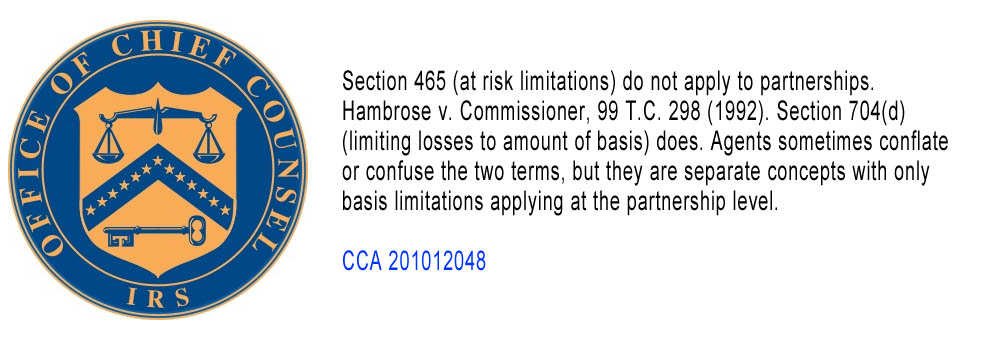
The advice is about whether a partnership provision that allows the general partner to order limited partners to bring their deficit capital account up to zero allows the allocation of recourse debt to that partner. The consequence of not replenishing the capital account is withholding of future distributions. If this worked the partners would have basis and arguably at-risk to claim losses beyond their investment without any real risk. The advice indicates that it does not work.
“Because a limited partner’s conditional obligation is not a payment obligation under § 1.752-2(b), the limited partner does not bear the economic risk of loss for a partnership liability.”
Moral of the story is that a partnership nerd who doesn’t know 752 is not a true partnership nerd.
Grace Kim of Grant Thornton covered the advice, which she prefaces as ILM rather than CCA, which is going to cause me to lose sleep in Tax Hot Topics.
“This IRS memorandum is a reminder that partnership agreements and related contractual obligations must impose a real, enforceable and unconditional payment obligation before a partner will be treated as bearing the economic risk of loss for Section 752 purposes. Payment obligations that are discretionary, contingent or otherwise avoidable may not support a recourse liability classification or allocation.”
A plentitude of sharp people like Grace Kim was one of the reasons I loved Grant Thornton. Just because a man loves a thing, doesn’t mean it has to love him back. Same thing happened with Forbes, only that was a much longer run.
Ed Zollars and LM Studio had something on the advice in Current Federal Tax Developments July 20, 2026.
Sad Story
I began covering John Anthony Castro in 2020 with a story about a bad signature voiding a refund claim. Then there was an aggressive position he was staking out on the potential deductibility of expenses paid with paycheck protection money. That was mooted by subsequent legislation. Castro had a unique attitude toward tax practice believing in the need to be hyper-litigious. He had focused an obscure issue about how Australian nationals taxed as US persons need to report transactions related to the Australian superannuation fund. I couldn’t help but admire his spirit while also feeling he was a bit over the top. In 2020 he wrote me
‘We’re a boutique firm that specializes in international tax planning, but each attorney is incredibly well-credentialed, published, and diligent. You can think of us as the Navy Seals of Tax Attorneys. What takes a team of 25 attorneys at a large firm to do; a single attorney at our firm can do.”
This reminded me a bit of a team at Grant Thornton, that would talk about “deploying”. There is something a bit off about using war/military metaphors for office jobs.
Then his virtual tax practice became a sort of refund shop where he came up with aggressive positions, prepared refund returns and took a percentage of the refund. Incidentally there was some political activity most notably a run for the 2024 GOP presidential nomination in order to get standing to sue against Trump’s candidacy. That’s around when the sky fell in for Castro. He was prosecuted for the way he ran his tax practice with the indictment coming out on January 3, 2024 and sentenced on October 30, 2024. He got 188 months, which I thought was pretty harsh. The sentence was driven by tax loss. On the other hand Paul Daugerdas, one of the architects of the turn of the millennium tax shelter craze only got fifteen years and that was commuted to nine by President Biden. Castro claims that his political activity triggered his prosecution.
On July 10, 2026, the Fifth Circuit issued an opinion on Castro’s appeal. He was looking for a new trial based on issues with the credibility of one of the witnesses against him and use of statements he made without proof that he had been “read his rights”. On the sentence he objected to sentence enhancements for being and organizer or leader and obstructing justice. He didn’t get anywhere with any of his arguments.
“In sum, Castro’s arguments are without merit. We lack jurisdiction to consider his trial-transcript challenge, and his Brady-based motion for a new trial fails on the merits. Similarly, he cannot show that his Confrontation Clause rights were violated or that the district court erred in applying sentencing enhancements under §§ 3B1.1(a) or 3C1.1.”
More Coming
I will see if I can give you the rest of July, before August is up.
——————————————————————————————————————————————————————————-

For great value in continuing professional education check out the Boston Tax Institute.
If you would like to do business with Your Tax Matters Partner email yourtaxmatterspartner@gmail.com