












































































Most Recent Posts

Low 1040 Refunds Threaten Household Finances
I don’t know whether the stories I read about people not being able to come up with four hundred bucks for an emergency are a sign of the times or a pretty universal condition. Think about Dr. Lydgate in Middlemarch or the father in Mill On The Floss . (If you have not read those works by George Eliot, finish this post and start on them. They are free on Kindle). If you are counting on your tax refund for solvency and your income is not on the abject poverty side, take a close look at your spending. It is really boring old fart advice, but sitting here in an RV in Florida at 67, I can tell you it works.

Tax Story Generates Excitement Because Of Minor Nick Saban Connection
As it happens I know somebody who is currently attending the University of Alabama. I reached out to him to find out why a Tax Court decision that marginally affected Saban would seem like a story to the sports press. He wrote me:
In Tuscaloosa, sororities will sometimes paint signs on their window proclaiming that Nick Saban, a 5’6″ 67 year old man, is the sexiest person alive. For reference, I’ve never seen any player treated the same.
So I guess it is not surprising that a Tax Court decision that marginally involves him can generate interest.
Notice 2019-07 250 Hour Requirement – What It Means And How To Meet It
Regardless, I would recommend that it is worth going to the trouble of complying. There are different approaches to representing taxpayers at audits. One guy I know goes with a hostile combative style. Some attorneys will adopt a litigation posture, forgetting that it is the client that has the burden proof.
My approach is that I am working with my fellow accountant who just happens to have a government job to arrive at the correct answer. Of course, I know that the correct answer is “no change”. My brother or sister accountant, verging on becoming my new BFF, just needs a little help to see that. Lavishing attention on something that is easy to get right helps in the process. That’s my theory anyway and, knock on wood, I’ve done pretty well over the years.
So ask your vendors for hours (not including drive time) and ask your real estate management company if they will provide you with a “Notice 2019-07 Compliance Report”. It’s going to be a thing. I’m sure of it.
Here Is The First Post On A 2019 Tax Court Decision
The name of the petitioner is, of course, public record and you can easily find it, but it is one of those cases where I figure the taxpayer does not need me to help him be more famous so I will call him Joe. The case is pretty much a mess and I would normally skip it, but I figure my readers must also be suffering from Tax Court Withdrawal Syndrome.

Where Convicted CPA May Have Gone Wrong
Back to 2012, when Berger’s staff raised the issue. At that point, the only thing that was clear was that Berger’s firm in following the management company’s numbers might have adopted an incorrect accounting method in 2007 or 2008, when the extra money started coming out of the fund. The dollars had gotten pretty big, so you really should not try to unscramble that egg on your own.
Conservation Syndicator EcoVest Responds To Injunction Threat
Evaluating conservation deals with high multiples as reasonable tax expenditures, they really come up kind of short. The government could actually buy the land for less than the tax expenditure. Tax incentives should really encourage people to do things, not do it for them and give them a bonus.
What Should Investors In Conservation Syndications Do When DOJ Seeks Injunction?
Terry should ask for the $20,000 back from EcoVest and consider supplementing the fourth-quarter estimate, although that probably won’t make much difference.
I spoke with EcoVest investor relations and they made it clear that they won’t just cut a check. Their point of view is that DOJ has arbitrarily struck demanding that five hard-working people, who are connected to EcoVest one way or another, are being asked to take up different work. Due to the government shutdown, they have not been able to respond.

Stormy Daniels On Employment Law
As Katie explained it to me there are two common types of deals between clubs and dancers. The dancer can just be getting cash tips and paying a fee to the club ($100 or $200 per night possibly). In that case, there will be no reporting. Technically, if the club is not a corporation, the dancer should be giving the club a 1099, but I doubt that ever happens.
In the other model, fees are paid by the patron to the club, which splits with the dancer and sends her a 1099.
In either event, the dancer is going home with cash every night. Whereas, now, according to Katie she is waiting two weeks for a paycheck.
Then there is the matter of deductible expenses. They don’t even mention 199A, but that would be another advantage of IC status.
On The Basis Of Sex: Watch The Other Lawyers
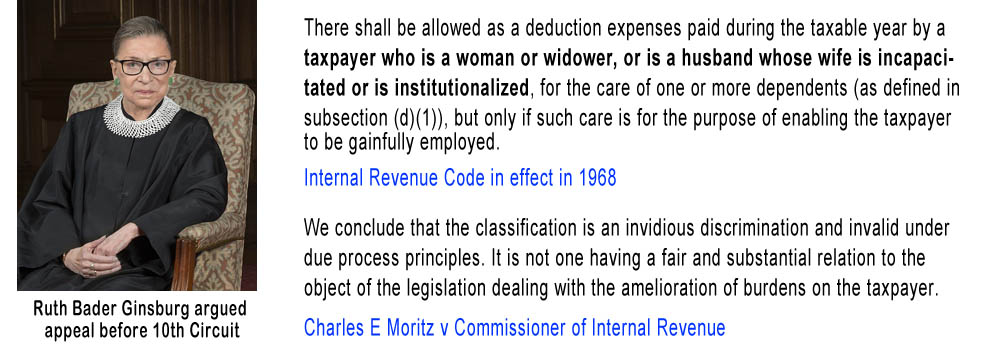
In his appeal to the Tax Court, Moritz wrote that if he had been a dutiful daughter he would have been allowed the deduction, but as a dutiful son, he was denied. To be fair to the Tax Court, my blogging buddy Lew Taishoff who follows the Tax Court with an incredible intensity let me know that the Tax Court cannot overturn a statute on Constitutional grounds. The mantra of the Tax Court is that it is a court of limited jurisdiction. When it comes to the Code it follows Reilly’s First Law of Tax Planning – It is what it is. Deal with it.
The Trial And Tribulation Of A CPA Tax Partner
And while the alarm bells are already sounding the CPA community, even Mr. Berger’s tax preparer peers are left without clear guidance on what to avoid besides crooked clients. Perusing the public docket for lessons, Reilly, himself a long-time CPA writes that it is still not clear to him what the right tax answer was on the Burrill returns in the first instance.