
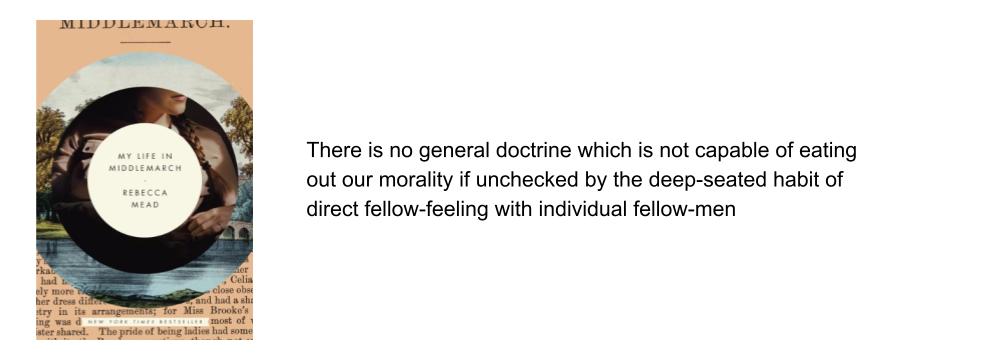
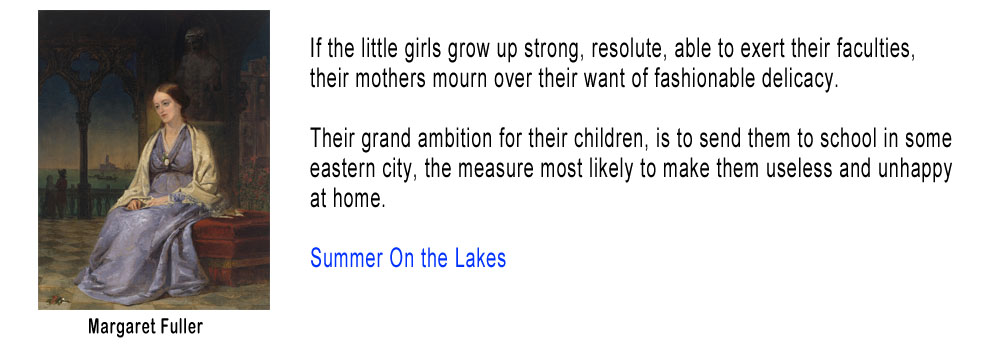





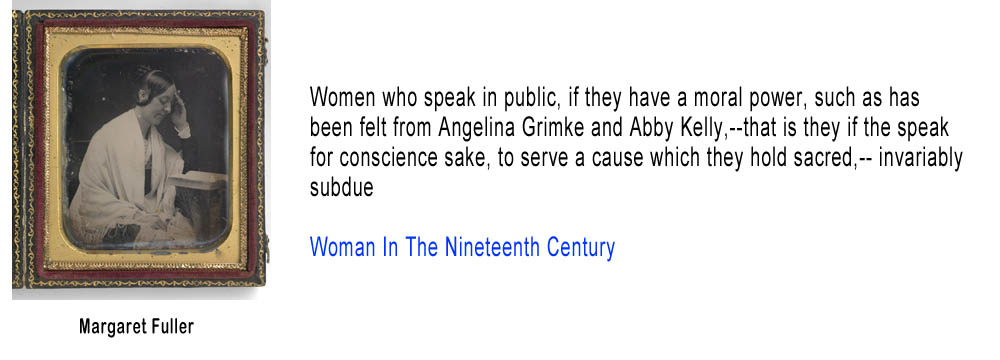
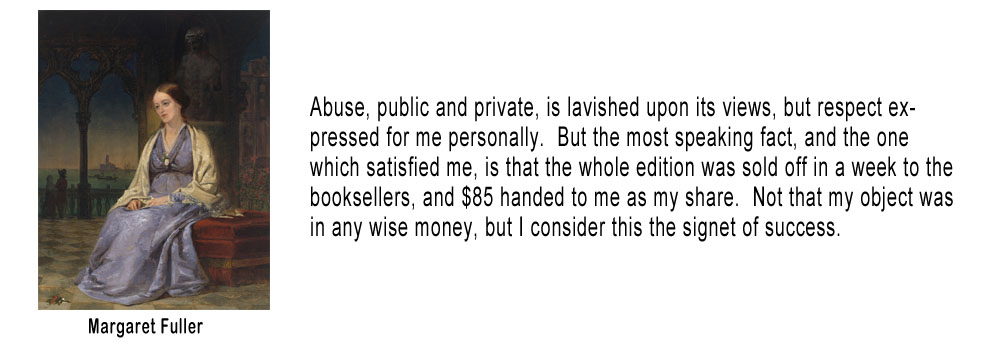
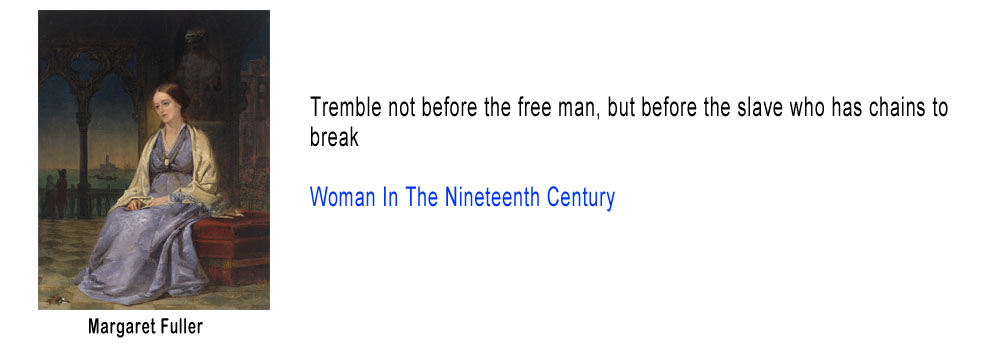

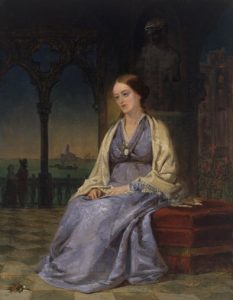
I don’t think the ideal Margaret Fuller novel will ever be written, but Carol Strickland’s effort certainly goes a long way. Traditionally there has been something of an obsession with Fuller’s effect on men so I was very pleased that Ms. Strickland opens with two women discussing the latest news about Margaret. They are Caroline Sturgis Tappan (Cary) and Sophia Peabody Hawthorne (Sophia). We catch the tension from the outset.
“You’re like Margaret.” Begrudging admiration tinged Sophia’s voice. “What do you hear from our crusading heroine, La Signora Margaret Fuller Ossoli?”
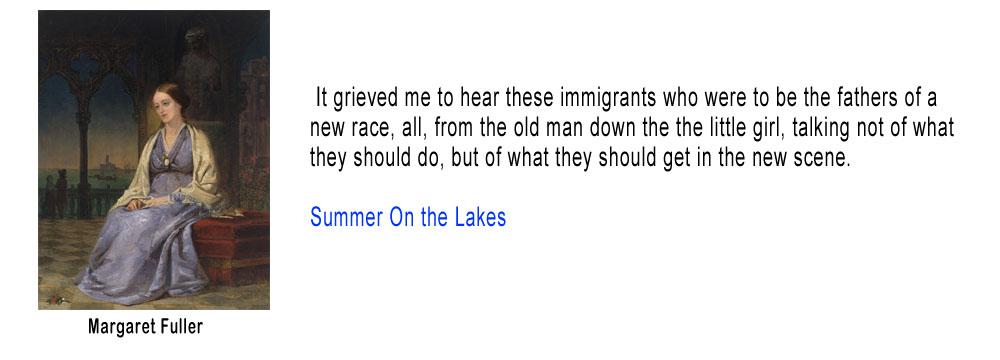
So we begin near the end with Margaret in Italy after a failed revolution as the scene shifts from Stockbridge, MA to Florence. We follow along with Margaret and her husband and child basically on the run. There is a meeting with Elizabeth Barrett Browning. Then we shift back to 1836 when Margaret is teaching at Bronson Alcott’s school where one of her prize pupils is the teenage Cary Sturgis. We move along to one of Margaret’s series of Conversations that includes both Sophia and Cary. I always thought it would be great to be a fly on the wall at the conversations that must have preceded THE Conversations. That’s what we need novelists for and Ms. Strickland carries it off well. In the Conversation conducted by Margaret Lidian Emerson is introduced in a sort of handmaid role.
The scene then shifts to Concord so we can meet Emerson, Thoreau and Hawthorne. I always have a hard time with this part of the story, which comes out of my own introduction to Margaret Fuller in 1972 while taking a course called Hawthorne, Melville and Twain with Margaret being sort of the girl Transcendentalist and the inspiration for Zenobia. As the years went by I had this nagging sense that she was more important but in my sort of random but still deep reading about the era she just didn’t come up much until I stumbled on Thomas Wentworth Higginson’s biography of her and learned the name Ossoli for the first time. Still this portion is important for what is coming.
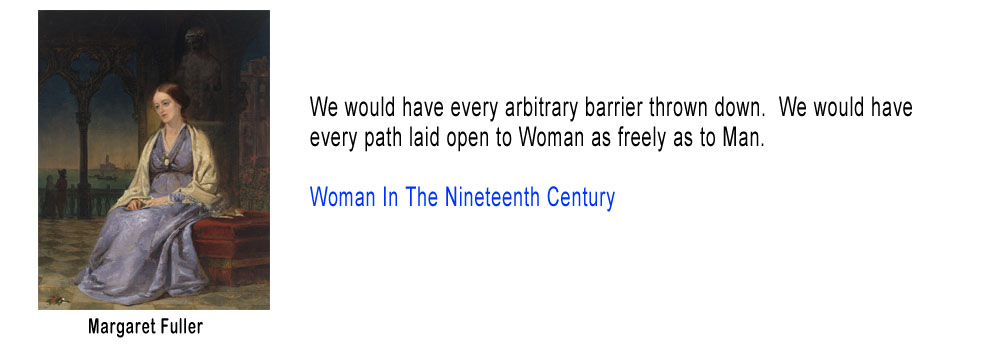
Nonetheless, it was great to get back on the main track as we move to Fishkill, New York and the Big Apple itself as Woman in the Nineteenth Century is finished and released. I’m particularly partial to the New York Margaret.
“After Boston’s prim Puritanism and Concord’s high-minded moralism, New York City agreed very well with Margaret. She adored her work at the Tribune, no matter how Waldo dismissed it as “running on a treadmill of newspaper foolishness.” Half a hundred thousand readers hung on her every written utterance. Her articles adorned the front page of the Tribune,”
The relationship or whatever it was with James Nathan gets some treatment. I was hoping for more. That thing is probably worth a novel of its own. I’m grateful that at least it wasn’t skipped. The main role the affair plays to move this story forward is the rare instance of brother-in-law Ellery Channing being right about something.
Also moving the story along is a meeting with Walt Whitman which is one of those things that should have happened and maybe even might have happened but left no footprint in the historic record.
We get coverage of Margaret’s meetings with George Sand and Adam Mickiewicz as she embarks on her tour of Europe. My big disappointment was no mention of the night alone on the Scottish moor. There has to be something left for other novelists to tackle. Like the meeting with Whitman a run-in with William Sturgis is probably meant to advance the story. The romance with Ossoli is handled very well. The novel includes another romantic interlude that while fictional is quite exciting. No spoilers on that.
The first half of the book ends with Margaret and Ossoli and their child on their way to America on the ill-fated slow boat.
The second half opens with news of Margaret’s tragic death and how the various characters react. This then leads to the dramatic setup. Walt Whitman, Nathaniel Hawthorne, Ralph Waldo Emerson, Herman Melville. Sophia Hawthorne, Caroline Sturgis Tappan (without husband Will), Lidian Emerson, Ellen Fuller Channing (Margaret’s sister) and her husband Ellery Channing, Captain William Sturgis (Cary’s father) and Henry David Thoreau are all gathered together to discuss how Margaret should be remembered. I couldn’t help but think of the Return of the Secaucus Seven as Whitman fills the function of the tag along boyfriend who has to have everything explained to him.
Here is Cary, whom I really like:
“Let me enlighten you about these fair-weather friends,” she offered. “Nat is a prig and detests any woman who dares be true to herself. Sophie is thoroughly indoctrinated. She used to love Margaret; now she fears her ideas. My father lives in the past, Lidian wraps herself in the mantle of saintly martyr, and Waldo is paralyzed by cowardice. Even Henry endures a lonely life.”
I sometimes got a little bogged down. In the film version, there might have to be some character compression. It was definitely worth going through as along with a seminar of first wave feminism, we get Melville gathering material for Moby Dick from Captain Sturgeon and Thoreau deciding that maybe his sojourn on Walden Pond could have a book made out of it. And then there is the mystery of Margaret’s history of the Roman Revolution, which is probably one of the most missed stories in European history. As the author admits much of it didn’t happen, but I really wish it did.
The biggest plus to this book is that it shows us Margaret Fuller seen through the eyes of other capable women playing the cards that they have been dealt by the mid-nineteenth century.
———————————————————————————————————————————————————————

For great value in continuing professional education check out the Boston Tax Institute.
If you would like to do business with Your Tax Matters Partner email yourtaxmatterspartner@gmail.com.
Margaret Fuller’s articles did not adorn the front pages of the New York “Tribune.” These reviews, essays and reports, signed with a single asterisk or “star,” were written by Mathew Franklin Whittier, reclusive younger brother of the famous Quaker poet, John Greenleaf Whittier. Fuller lied in correspondence to a few of her close friends and family members, that she was the author; then, she allowed the rumor to develop unchecked. Mathew had also written all the “F.”-signed reviews in “The Dial” which Fuller claimed. She published 13 of these works as her own in her 1846 compilation, “Papers on Literature and Art,” the month before she left for Europe.
Do you have any sources that support this theory?
Here is what my pal Grok has to say about it.
Stephen Sakellarios’s theories about Margaret Fuller’s authorship are fringe claims without support in mainstream literary scholarship or primary historical evidence. They allege that Fuller did not write (or at least did not write most of) the literary reviews, essays, and reports signed with a star (asterisk) in the New-York Tribune (1844–1846) or those signed “F.” in the early issues of The Dial (1840–1841). Instead, Sakellarios attributes them to Mathew Franklin Whittier (1812–1883), the lesser-known younger brother of poet John Greenleaf Whittier, and accuses Fuller of dishonest appropriation/plagiarism when she reprinted eleven of the pieces in her 1846 collection Papers on Literature and Art.
Context and Sakellarios’s Claims
Margaret Fuller (1810–1850) is a major figure in American Transcendentalism and early feminism. Horace Greeley hired her as the Tribune’s literary editor in late 1844; she lived with the Greeley family in New York and produced roughly 240 star-signed pieces (reviews, essays, and cultural reports) over about 20 months before departing for Europe as the paper’s foreign correspondent in 1846. She had previously edited The Dial (the Transcendentalist journal) and contributed to it, including under initials or anonymously. Scholarly editions, such as Margaret Fuller, Critic: Writings from the New-York Tribune, 1844–1846 (edited by Judith Mattson Bean and Joel Myerson), treat these works as hers on the basis of employment records, her correspondence, Greeley’s own accounts, contemporary references, and stylistic/ biographical consistency.
Sakellarios, an independent researcher, has self-published papers (primarily on Academia.edu), video blogs, and a personal website arguing the opposite. His key points include:
The star signature was used by Whittier across decades (from the late 1820s onward) in various obscure publications, predating Fuller’s Tribune tenure and continuing afterward. He interprets it as a personal/metaphysical symbol tied to Whittier’s late wife, Abby Poyen.
Stylistic analysis: The pieces show Quaker-influenced humor, intricate intertextual references, and personal anecdotes that allegedly match Whittier’s life and known (limited) output far better than Fuller’s “romantic and superficial” style.
Volume and capability: Fuller supposedly lacked the time, depth, or output capacity for ~238 star-signed Tribune items plus other work; Whittier, a prolific but obscure writer under many pseudonyms, fits better.
Plagiarism charge: By claiming and reprinting the pieces in Papers on Literature and Art, Fuller knowingly passed off Whittier’s work as her own.
These arguments are part of Sakellarios’s much larger project: he claims Whittier was the uncredited author of dozens of famous 19th-century works, including Charles Dickens’s A Christmas Carol (co-authored with Abby), several poems by Elizabeth Barrett Browning, and Edgar Allan Poe’s “The Raven” and “Annabel Lee.” He began this research after believing he himself was the reincarnation of Mathew Franklin Whittier (discovered via past-life awareness around 2005–2009).
Evaluation of the Theories
Sakellarios’s claims fail on multiple grounds and are not engaged with (or even mentioned) in any peer-reviewed scholarship on Fuller, Greeley, the Tribune, The Dial, or Transcendentalism.
Methodological and evidential weaknesses: His case rests on subjective stylistic comparison and signature continuity. These are common tools in authorship studies but require rigorous controls, external corroboration, and peer review—none of which are present. No primary documents (letters, diaries, contracts, or contemporary testimony) link Whittier to the Tribune or Dial in this capacity. Whittier’s documented output is narrow (mainly the satirical “Ethan Spike” dialect letters); there is zero independent record of him producing hundreds of high-profile literary reviews in New York papers.
Contradiction by direct historical evidence: Greeley explicitly hired Fuller as literary editor and referenced her contributions positively in his reminiscences. She lived with his family, corresponded about her work, and her Tribune output aligns with her known interests, evolving feminist philosophy, and Transcendentalist circle. Fuller herself collected selected pieces under her name in 1846 with no contemporary challenge. Scholarly archives (e.g., the Margaret Fuller Transnational Archive) and biographies treat her authorship as settled.
Bias and context: Sakellarios’s research is explicitly motivated by a personal reincarnation belief, creating strong confirmation bias. His broader conspiracy narrative (a “gang” of 19th-century literary plagiarists fooling academia) is classic pseudohistory—pattern-seeking without falsifiable standards or external validation. His work appears only on self-published platforms, not in academic journals.
Reception: No historians, literary critics, or Fuller scholars cite or debate his papers. Searches for any academic response turn up nothing; the claims exist in an echo chamber of his own videos, Facebook comments, and personal sites. Mainstream sources (JSTOR articles, Oxford editions, biographies) continue to affirm Fuller’s authorship without qualification.
In short, Sakellarios has produced a volume of amateur research and stylistic speculation, but it does not meet the standards of historical or literary scholarship. The theories are interesting as an example of outsider “rediscovery” driven by personal conviction, yet they are unsupported and contradicted by the documentary record. Established evidence leaves no reasonable doubt that Margaret Fuller authored the star-signed Tribune criticism and her Dial contributions. Claims to the contrary remain unsubstantiated pseudohistory.
wish you all the best