









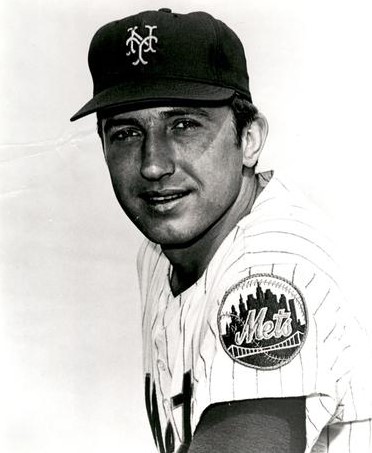
One of the things I read religiously is the New York Times obituaries. They are really brilliant. Sometimes they will trigger vivid memories. Rarely, they will inspire a tax story. A recent obituary managed to do both. And to add to the satisfaction it confirmed that, as I firmly believe, I am better at covering tax stories than the New York Times. Nothing like opening with a dash of arrogance. Anyway the obituary in question is of major league pitcher Jerry Koosman (1942-2026).
The Memory
In 1969 I was living in Fairview NJ and commuting to high school in Manhattan. Xavier High School 30 West 16th. Orange and Black bus to Port Authority bus terminal. “A” train to 4th street and some other letter one station uptown to 14th street. Subway riders did not socialize with one another much, but there was this magical time and I picture myself in my military uniform (It wasn’t just a high school. It was an Institute. And we weren’t just a student body. We were a Regiment.) talking to a grown up probably heading down to his job on Wall Street, like my old man had for all his life and I had for two summers. We were excitedly talking about the current big event. The Mets, who had not had a winning season in their first seven years of existence were in the World Series. My other two memories of the Mets are seeing their first Polo Grounds game in 1962 on television because I was home with the mumps. They lost. And on the extraordinary side being in Shea Stadium on Fathers Day in 1964 “keeping score” and turning to my old man as the seventh inning closed and saying “Dad, this is a perfect game”. Unfortunately Jim Bunning was pitching against the Mets. So having them in the World Series was really something enough even to get strangers talking to each other on the A train.
The Story
The Mets won the World Series in 1969 and Jerry Koosman pitched the final game. He never got as much attention as Tom Seaver and did not make the Hall of Fame. On the other hand, in 2021 he became the third Met to have his number (36) retired. You can get more details about his baseball career from the obituary or you could invest twenty-five minutes of lifespan you will never get back in this video
Here is the detail in the obituary that got me excited rather than notstalgic.
“In 2009, Koosman pleaded guilty to failing to pay federal income taxes for 2002, 2003 and 2004, and defrauding the government out of as much as $90,000. He spent six months in prison. He said that he had been “naïve” and mistakenly believed that federal tax laws did not apply to him.”
The obituary writers relied on the New York Post rather than going to primary sources. I’ll try to give you a fuller version. I won’t leave you in suspense about what was wrong in the Times obituary. Although Koosman, was originally sentenced to six months, Judge Barbara Crabb apparently at the request of the government (a few of the documents in the case remain sealed) reduced his sentence to five months of which a little more than four months was served. I guess it is not that big a deal but somehow NYT relying on a report in the New York Post when the original source material is available seems a little shocking. Here is some more of the story.
Jerry Koosman got caught up in what is variously referred to as the “tax protester” movement or being a “sovereign citizen”. Striving to be nonjudgmental, I call people who do that sort of thing not conventionally tax compliant (NTC) and the people who inspire them alternative tax thinkers (ATT). A conventionally tax compliant person (CTC) believes that if you are living in the United States and have more than insubstantial income, you probably need to file an individual tax return. If they have any doubt, they resolve the doubt by following Reilly’s Seventh Law of Tax Planning – Read the instructions. The NTC have a lot of other things they read which tend to lead them to the wrong conclusion.
The Investigation
Much of this story is drawn from an affidavit attached to an application for a search warrant on Koosman’s home. There are also Koosman’s sentencing memorandum and the government’s response. Some bits come from news accounts of the sentencing hearing for which there is no transcript.
On March 28, 2006, IRS Special Agent Steven M. Makowski called on Koosman at his fiance’s home on 1416 Ridge Run, New Richmond MI. Makowski had been with IRS for almost twenty years starting as a Revenue Agent in 1988 and becoming a special agent with Criminal Investigation in 1993. Makowski was accompanied by Special Agent Eric Kopp.
He was aware that Koosman had not filed returns for 2002, 2003 and 2005. IRS records indicated that he had income in those three years in the amounts of $610,258, $90, 316 and $54,373 respectively. Koosman had filed in 2000 and 2001 married filing joint with taxable incomes of $56,326 and $76,263, The high 2002 income was related to a stock sale of Minnesota Corn Processors after they were acquired by Archer Midland. Maknowski noted that Koosman had reduced the withholding on his pension income after 2002.
LaVonne Koosman filed her 2002 return married filing separately. Divorce went through in 2003 and she began filing as single. There is no indication as to whether Koosman’s shifting to not being conventionally tax compliant was a factor in their breakup. Regardless, it is likely that LaVonne filing separately was a very smart move on her part.
When Koosman was asked why he had not filed his last three returns, he answered “Why should I?”. He asked Makowski to show him the law that required him to file a federal income tax return because he believed no such law existed. He complained about an illegal lien on his property. It was illegal because it was not signed by a judge. He had been looking for a due process hearing and indicated that the IRS could not take him to court, because they had not done a 23C Assessment Certificate. He pointed to a small booklet that included excerpts from the Constitution that proved that taxes did not apply to him. The income tax in Koosman’s view only applied to federal employees, corporate employees and residents of the District of Columbia.
Koosman showed the agent 3 binders with copies of letters, correspondence, documents and his research into IRS procedures and federal tax laws. Koosman indicated that he had been researching for seven years. Makowski noted that Koosman frequently said “we” when discussing these matters. Asked who constituted “we” Koosman mentioned Judge John Rizzo, who somehow I have missed, and Joe Banister, whom I have covered. Joseph Banister was an IRS special agent. Researching to refute protester arguments, he concluded that some of them were correct. Banister is still active styling himself Agent for Truth.
What happens next illustrates why you don’t invite federal agents into your home if they don’t have a warrant. Makowski spotted on the bookshelves “Know You Rights” and “Tax Resolutions“. I don’t know why those in particular were worth noting. More significant was what was on the computer screen – IMFDECODER.COM. “IMF Decoder” was a trade name of Sharon Diane Kukhahn. In 2008, there would be an injunction telling Kukhahn to stop providing her services that purportedly decoded your Individual Master File to show that you were tax-exempt. While Koosman was doing his short stint she was sentenced to seven years.
When I was a hotel night auditor I would take my breaks in the darkened coffee shop. Local cops would stop in and chat with the third shift hotel employees. The cops had more interesting stories. One of the things they talked of was the crime of B and A. It stood for Being An Asshole. It could get you arrested and they would figure out the statute you broke afterwards. There is a whiff of that attitude in Makowski’s affidavit.
“individuals who have the mindset of Mr. Koosman will not cooperate with the IRS through normal channels of communication.””Instead, Koosman and others purposley file a voluminous amount of papwerwork with the IRS challenging well-established law with the intention of bogging down the resources of the IRS and hidering the lawful function of the IRS to collect income taxes.
individuals who file a voluminous amount of paperwork and challenges with the IRS are usually schooled by others and/or subscribe to websites whose purpose is to hinder the lawful collection of taxes.”
According to news reports the ultimate search turned up much more tax protester material.
How It Worked Out
Jerry Koosman woke up, smelled the coffee and lawyered up. There is a defense based on a Supreme Court decision called the “Cheek defense”, which is ironic because it ended up not helping John L. Cheek who was convicted on retrial. The idea is that if you sincerely believe your oddball interpretation then your failure to file is not willful and therefore not criminal. You still owe the taxes and the interest and the penalties. And Koosman’s network probably helped him find the right lawyer. Robert G. Bernhoft successfully defended Joseph Banister in 2005. In 2008 he defended Wesley Snipes getting acquittals on all felony charges, although losing on misdemeanor charges.
Rather than attempt a Cheek defense, Koosman pleaded guilty to a single misdemeanor count. You should keep in mind that independent of length of sentence, a felony conviction has other consequences that can last a life time. I wrote to attorney Bernhoft to get some comment on how things went. Here is his response:
“Yes, we represented former “Miracle Mets” pitcher Jerry Koosman in a criminal tax case in the Western District of Wisconsin (Madison) back in 2009. He was charged by Information with a single misdemeanor count of willful failure to file a tax return.The only documents that are sealed are related to the Government’s motion for a sentence reduction. Judge Crabb ultimately granted that sealed motion and reduced Jerry’s sentence from 6 to 5 months. We have all of those sealed filings but they remained sealed, and I therefore cannot discuss the reason they were sealed or their contents.Jerry was great to work with. He regaled me with numerous wonderful stories of his days with the Mets, including the time the Government asked he and his New York City ballplayer roommates for permission to stage a video surveillance operation in their house, directed at an organized crime operation across the street. (Jerry gave me permission to discuss certain aspect of his case, for purposes of media interest and inquiries).The result we obtained for Jerry was indeed excellent – given the Government was prepared to charge felony tax evasion – with Jerry pleading to a single tax misdemeanor, which is a very rare concession by the Government in criminal tax cases due to the so-called “top-count felony” plea rule. You can draw your own conclusions as to why Jerry elected not to go to trial and present a Cheek good faith reliance defense.AUSA John Vaudreuil was the consummate professional career prosecutor. I don’t believe either IRS Criminal Investigation or AUSA Vaudreuil were motivated to criminally investigate Jerry because of his celebrity. But Judge Barbara Crabb made specific references to Jerry’s celebrity status as justification for the custodial sentence she imposed, which was somewhat unusual in a federal misdemeanor case with a first-time offender, where probation was an available option.”
*No unsealed document or public report explicitly states that Koosman was a paying customer of Kukhahn or that he provided the assistance that led to the Rule 35 motion. Customer lists and cooperation details in these matters are typically sealed. The absence of a public link is therefore expected and does not rule out the connection.In short, the sealed government motion for a post-sentencing reduction, the close match between Koosman’s stated beliefs and materials and Kukhahn’s documented pitch, and the timing relative to her indictment make a connection reasonable to infer. It is consistent with how the government has handled other tax-protester promoter cases involving customer cooperation. Confirmation would require unsealing or access to the sealed materials, which is not available from public records.”
Alternative Tax Thinkers Still At Work
Me And The Mets
For an American male, my knowledge and interest in sports is on the low side. Too much tax litigation, history and science fiction to read, but I have noticed how sports sort of ties the country together. People from different regions will know about the other’s teams and it gives them something to talk about.
I grew up in the metro New York area, but have mostly lived in Massachusetts since 1970. That places me in the center of a perennial baseball rivalry (Red Sox – Yankees), which is probably felt more strongly in Massachusetts, which I believe has the strongest loyalty to its professional teams than anywhere else in the country. I seem to have a gift for catching historic sports moments while being an irregular watcher. The other big Mets moment I will never forget I caught on TV. It actually has a wikipedia entry – Bill Buckner’s 1986 World Series error. The Red Sox almost broke the curse and were foiled by the Mets, who have not take a series since.
A sign of the strength of the devotion to Boston professional teams is air travel. It is always easy to spot the Boston or Providence gates by the Red Sox, Patriots, Celtics and Bruins gear. I started interviewing people about why they were wearing the gear and quite frequently it was more a statement of regional identity than fandom. So I joined in. Whenever I am not in New England, I where a Red Sox hat. When I am in New England, I wear a Mets hat, which I believe is more distinctive than a Yankees hat. They are both great conversation starters.
——————————————————————————————————————————————–

For great value in continuing professional education check out the Boston Tax Institute.
If you would like to do business with Your Tax Matters Partner email yourtaxmatterspartner@gmail.com